 |
List of Publications - ACM
Programme |
|
|
| |
Click here to browse
the list of published papers and books.
|
|
Responding to Environmental Issues through Adaptive Collaborative Management: From Forest Communities to Global Actors
By Colfer, C.J.P.; Prabhu, R.
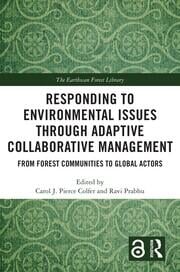 Focused on forest management and governance, this book examines two decades of experience with Adaptive Collaborative Management (ACM), assessing both its uses and improvements needed to address global environmental issues.
The volume argues that the activation and the empowerment of local peoples are critical to addressing current environmental challenges and that this must be enhanced by linking and extending such stewardship to global and national policymakers and actors on a broader scale. This can be achieved by employing ACM’s participatory approach, characterized by conscious efforts among stakeholders to communicate, collaborate, negotiate and seek out opportunities to learn collectively about the impacts of their action. The case studies presented here reflect decades of experience working with forest communities in three Indonesian Islands and four African countries. Researchers and practitioners who participated in CIFOR’s early ACM work had the rare opportunity to return to their research sites decades later to see what has happened. These authors reflect critically on their own experience and local site conditions to glean insights that guide us in more effectively addressing climate change and other forest-related challenges. They showcase how global and regional actors will have to work more closely with smallholders, Indigenous Peoples and local communities, recognizing the key local roles in forest stewardship.
This book will be of great interest to students, scholars and practitioners working in the fields of conservation, forest management, community development, natural resource management and development studies more broadly.
|
|
Adaptive Collaborative Management in Forest Landscapes: Villagers, Bureaucrats and Civil Society
By Colfer, C.J.P.; Prabhu, R.; Larson, A.M.; (eds.)
 This book examines the value of Adaptive Collaborative Management for facilitating learning and collaboration with local communities and beyond, utilising detailed studies of forest landscapes and communities. Many forest management proposals are based on top-down strategies, such as the Million Tree Initiatives, Forest Landscape Restoration (FLR) and REDD+, often neglecting local communities. In the context of the climate crisis, it is imperative that local peoples and communities are an integral part of all decisions relating to resource management. Rather than being seen as beneficiaries or people to be safeguarded, they should be seen as full partners, and Adaptive Collaborative Management is an approach which priorities the rights and roles of communities alongside the need to address the environmental crisis. The volume presents detailed case studies and real life examples from across the globe, promoting and prioritizing the voices of women and scholars and practitioners from the Global South who are often under-represented. Providing concrete examples of ways that a bottom-up approach can function to enhance development sustainably, via its practitioners and far beyond the locale in which they initially worked, this volume demonstrates the lasting utility of approaches like Adaptive Collaborative Management that emphasize local control, inclusiveness and local creativity in management. This book will be of great interest to students, scholars and practitioners working in the fields of conservation, forest management, community development and natural resource management and development studies more broadly.
“See also Book Talk by Carol Colfer at Cornell University Library”.
|
|
DARI DESA KE DESA: Dinamika Gender dan Pengelolaan Kekayaan Alam
Editor Indriatmoko, Y.; Yuliani, E. L.; Tarigan, Y.;
Gaban, F.; Maulana, F.; Munggoro, D. W.; Lopulalan, D.; and
Adnan, H. , all at CIFOR,
Indonesia
 Masih
ingat acara Dari Desa ke Desanya TVRI yang dibawakan oleh Sambas
Mangundikarta pada tahun 1980-an? Nah buku ini ada kemiripannya
ketika menceritakan episode-episode masyarakat pedesaan dari
banyak tempat di Indonesia. Narasinya berasal dari berbagai
pelosok negeri ini, mulai Jambi di Sumatera sampai Bantimurung
di Sulawesi. Bedanya, jika acara TVRI itu menyajikan sebuah
keharmonisan, untuk tidak menyebutnya keberhasilan ‘pembangunan’
di pelosok pedesaan, justru kumpulan tulisan ini menggambarkan
sebaliknya: betapa pembangunan belum berbuah kesejahteraan,
bahkan tak jarang pembangunan malah makin memiskinkan masyarakat.
Betapa tidak, demi pembangunan, sumberdaya alam tak
henti-hentinya dihabisi, mulai dari kegiatan pertambangan,
proyek transmigrasi, penebangan hutan, dan berbagai kegiatan
eksploitasi besar-besaran terhadap sumberdaya alam. Tidak perlu
diceritakan lagi bagaimana dampak dari eksploitasi ini terhadap
bencanabencana alam yang terjadi silih berganti di negeri ini.
Ironisnya, justru perempuan (dan anak-anak) adalah korban utama
dari kerusakan lingkungan. Padahal berbagai studi memperlihatkan
bahwa perempuan juga memiliki peran besar dalam pengelolaan
sumberdaya alam. Kalau kita menengok hasil kajian yang dilakukan
Neuman dan Hirsch (2000)1, nampak bahwa di seluruh dunia,
perempuan memanen dan mengolah hasil hutan bukan kayu untuk
dijual. Bagi perempuan miskin Maranhao, Brazil, menyadap inti
palem babacu menjadi sumber pendapatan terpenting mereka.
Kegiatan ini melibatkan lebih dari 300.000 keluarga. Para
perempuan di Botswana, India, Malaysia dan banyak negara lain,
menganyam keranjang, tikar dan piring dari produk hutan. Para
perempuan di hutan-hutan tropis juga mengumpulkan atau mengolah
bijibijian dan buah-buahan liar, tumbuhan obat dan jantung palem.
|
Download Full Paper (9 MB in PDF format) |
|
|
|
KEHUTANAN
MULTIPIHAK
Langkah Menuju Perubahan
Editor by Elizabeth Linda Yuliani, Djuhendi
Tadjudin, Yayan Indriatmoko, Dani W Munggoro, Farid Gaban,
Firkan Maulana, all at CIFOR,
Indonesia
 Buku
ini dimaksudkan untuk membantu staf proyek dan para fasilitator
lapangan dalam mendampingi masyarakat dan lembaga lokal
berkaitan dengan pengelolaan hutan. Buku ini menyarikan
pengalaman tim peneliti CIFOR dan pendampingpendamping
masyarakat serta staf lainnya dari tiga LSM mitranya1 di
Indonesia, selanjutnya disebut tim.
Tim tersebut melaksanakan penelitian aksi partisipatif tentang
suatu pendekatan yang disebut adaptive collaborative management
(ACM). Apabila pendekatan ini diterjemahkan ke dalam bahasa
Indonesia, kita dapat menggunakan istilah “pengelola an bersama
secara adaptif” (PBA). Walaupun demikian, buku ini menggunakan
istilah dalam bahasa Inggris untuk menghindari kerancuan,
mengingat berbagai istilah, singkatan, ataupun akronim yang
berkenaan dengan pengelolaan hutan banyak bermunculan dewasa ini
di Indonesia. Meskipun begitu, dalam merujuk pada pendekatan ini,
pembaca tentu memiliki kebebasan dalam memilih penggunaan bahasa
yang dipandangnya tepat untuk konteks kegiatannya. Proses
penelitian berlangsung dari tahun 2000 sampai 2002 dan
dilaksanakan di dua lokasi di Indonesia, yaitu di Propinsi Jambi
di Sumatera dan Propinsi Kalimantan Timur.
Penelitian serupa dilaksanakan juga di Bolivia, Brasilia,
Filipina, Gana, Kamerun, Kirgistan, Madagaskar, Malawi, Nepal,
dan Zimbabwe. Sama seperti penelitian di Filipina dan Nepal,
Bank Pembangunan Asia (ADB) membiayai penelitian yang
dilaksanakan di Indonesia.
Buku ini dimaksudkan untuk berbagi pengalaman dan temuan-temuan
yang diperoleh dari penelitian ACM di Indonesia.
|
Download Full Paper (8.7 MB in PDF format) |
|
|
|
BELAJAR BERADAPTASI
Bersama-sama Mengelola Hutan di Indonesia
By Trikurnianti Kusumanto, Elizabeth Linda Yuliani,
Phil Macoun, Yayan Indriatmoko and Hasantoha Adnan, all at CIFOR,
Indonesia
 Buku
ini dimaksudkan untuk membantu staf proyek dan para fasilitator
lapangan dalam mendampingi masyarakat dan lembaga lokal
berkaitan dengan pengelolaan hutan. Buku ini menyarikan
pengalaman tim peneliti CIFOR dan pendampingpendamping
masyarakat serta staf lainnya dari tiga LSM mitranya1 di
Indonesia, selanjutnya disebut tim.
Tim tersebut melaksanakan penelitian aksi partisipatif tentang
suatu pendekatan yang disebut adaptive collaborative management
(ACM). Apabila pendekatan ini diterjemahkan ke dalam bahasa
Indonesia, kita dapat menggunakan istilah “pengelola an bersama
secara adaptif” (PBA). Walaupun demikian, buku ini menggunakan
istilah dalam bahasa Inggris untuk menghindari kerancuan,
mengingat berbagai istilah, singkatan, ataupun akronim yang
berkenaan dengan pengelolaan hutan banyak bermunculan dewasa ini
di Indonesia. Meskipun begitu, dalam merujuk pada pendekatan ini,
pembaca tentu memiliki kebebasan dalam memilih penggunaan bahasa
yang dipandangnya tepat untuk konteks kegiatannya. Proses
penelitian berlangsung dari tahun 2000 sampai 2002 dan
dilaksanakan di dua lokasi di Indonesia, yaitu di Propinsi Jambi
di Sumatera dan Propinsi Kalimantan Timur.
Penelitian serupa dilaksanakan juga di Bolivia, Brasilia,
Filipina, Gana, Kamerun, Kirgistan, Madagaskar, Malawi, Nepal,
dan Zimbabwe. Sama seperti penelitian di Filipina dan Nepal,
Bank Pembangunan Asia (ADB) membiayai penelitian yang
dilaksanakan di Indonesia.
Buku ini dimaksudkan untuk berbagi pengalaman dan temuan-temuan
yang diperoleh dari penelitian ACM di Indonesia.
|
Download Full Paper (4.9 MB in PDF format) |
|
|
|
LEARNING TO ADAPT: Managing Forests Together in Indonesia
By Trikurnianti Kusumanto, Elizabeth Linda Yuliani,
Phil Macoun, Yayan Indriatmoko and Hasantoha Adnan, all at CIFOR,
Indonesia
 This
book aims to support fi eld-based facilitators and project staff
who assist local communities and other groups in managing the
forest. It draws on the experience of a team of researchers from
CIFOR who worked together with community facilitators from three
Indonesian partner non-governmental organisations (NGOs)1.
The team conducted its research on an approach that is called
adaptive collaborative management (ACM). The research process
took place from 2000 to 2002 and was carried out in two
Indonesian sites: Jambi province in central Sumatra and East
Kalimantan province.
Similar research was conducted in Bolivia, Brazil, Cameroon,
Ghana, Kyrgyzstan, Madagascar, Malawi, Nepal, the Philippines,
and Zimbabwe. As in the case of Nepal and the Philippines, the
Asian Development Bank funded the Indonesian research. This book
shares the team’s experience and the fi ndings of their
research.
|
Download Full Paper (4.9 MB in PDF format) |
|
|
|
The Complex Forest
Communities, Uncertainty, and Adaptive Collaborative Management
By Carol J. Pierce Colfer, CIFOR, Indonesia
 The
Complex Forest systematically examines the theory, processes,
and early outcomes of a research and management approach called
adaptive collaborative management (ACM). An alternative to
positivist approaches to development and conservation that
assume predictability in forest management, ACM acknowledges the
complexity and unpredictability inherent in any forest community
and the importance of developing solutions together with the
forest peoples whose lives will be most affected by the
outcomes.
Building on earlier work that established the importance of
flexible, collaborative approaches to sustainable forest
management, The Complex Forest describes the work of ACM
practitioners facing a broad range of challenges in diverse
settings and attempts to identify the conditions under which ACM
is most effective. Case studies of ACM in 33 forest sites in 11
countries together with Colfer’s systematic comparison of
results at each site indicate that human and institutional
capabilities have been strengthened. In Zimbabwe, for example,
the number of women involved in decisionmaking soared. In Nepal,
community members detected and sanctioned dishonest community
elites. In Cameroon and Bolivia, learning programs resulted in
better conflict management. These are early results, but a wide
range of recent research supports Colfer’s belief that these new
capabilities will eventually contribute to higher incomes and to
sustainable improvements in the health of forests and forest
peoples.
The Complex Forest reinforces calls for change in the way we
plan conservation and development programs, away from
command-and-control approaches, toward ones that require
bureaucratic flexibility and responsiveness, as well as greater
local participation in setting priorities and problem solving.
|
|
The Equitable Forest
Diversity and Community in Sustainable Resource Management
Editor by Carol J. Pierce Colfer, CIFOR, Indonesia
 While
there continues to be refinement in defining and assessing
sustainable management, there remains the urgent need for
policies that create the conditions that support sustainability
and can halt or slow destructive practices already underway.
Carol Colfer and her contributors maintain that standardized
solutions to forest problems from afar have failed to address
both human and environmental needs. Such approaches, they argue,
often neglect the knowledge that local stakeholders have
accumulated over generations as forest managers and do not
address issues involving the diversity and well-being of groups
within communities. The contributors note that these problems
persist despite clear evidence that equity and social
relationships, including gender roles, are important factors in
the ways that communities adapt to change and manage forest
resources overall.
The Equitable Forest offers an alternative to traditional,
externally organized strategies for forest management. Termed
adaptive collaborative management (ACM), the approach tries to
better acknowledge the diversity, complexity, and
unpredictability of human and natural systems. ACM works to
strengthen local institutions and use the knowledge and capacity
of groups in local communities to enhance the health and
well-being of both forests and the people who live in and around
them.
The Equitable Forest provides a detailed explanation of the
descriptive, analytical, and methodological tools of ACM, along
with accounts of early stages of its implementation in tropical
regions of Asia, Africa, and Latin America. Although the
contributors make it clear that it is too soon to evaluate the
efficacy of ACM, their work is supported by evidence that rural
communities do make important contributions when involved in
formal forest management; that management strategies are most
effective when flexible and tailored to local contexts; and that
efforts by outside governmental and nongovernmental
organizations to support local management are feasible from the
policymaking perspective, and desirable for their impact on
human, economic, and environmental well-being.
A copublication with the Center for International Forestry
Research (CIFOR).
|
|
Politics of Decentralization: The Forests, Power and People
Edited by Carol J. Pierce Colfer and Doris Capistrano, both at CIFOR, Indonesia
Part of the Earthscan Forestry Library
 Examines
the huge, global and local impacts of decentralization on
forests, biodiversity, conservation and the livelihoods of
people
In-depth case studies covering Europe/UK, North and South
America, Asia, Australia and Africaca
Research supported by the major international forestry and
conservation organizations including CIFOR, IUCN, WWF, UNFF,
ITTO, FAO, USFS, World Bank and ProForest
Decentralization is sweeping the world and having dramatic
and far-reaching impacts on resource management and livelihoods,
particularly in forestry. This book is the most up-to-date
examination of the themes, experiences and lessons learned from
decentralization worldwide. Drawing on research and support from
all of the major international forestry and conservation
organizations, the book provides a balanced account that covers
the impact of decentralization on resource management worldwide,
and provides comparative global insights with wide implications
for policy, management, conservation and resource use and
planning.
|
|
Management
tools for using and preserving natural resources: Criteria
and Indicators For Multiple Use of Forests in Andean Patagonia
of Argentina
by Carabelli F. A.*, M. M. Jaramillo, D. Szulkin-Dolhatz
& M. Gómez (Patagonian
Andes Forest Research and Extension Center (CIEFAP), Patagonia,
Argentina)
Abstract
Practical application of a set of criteria, indicators and
verifiers (C, I & V ) is presented. They are based on
those suggested by the International Center of Forest Research
(CIFOR) and have been specifically developed for a variety
of uses in the Andean Patagonian forest region in Argentina.
Considered uses are timber extraction, tourist and recreational
use, cattle-breeding and agroforestry. These C, I & V
were exhaustively discussed in an Interinstitutional Workshop
where technicians of every related national and provincial
institutions participated. During this meeting many of these
C, I & V were agreed and improved while others must be
greatly enhanced. With most of those C, I & V already
accepted a Technical Normative was prepared, being the current
internal official regulation employed by the local Forest
Service to assess plans for multiple use of forests. All plans
for multiple use of forest resources already presented by
private professionals to the Forest Service of Chubut for
evaluation and authorization were analyzed to get a first
approach of the plausibility of this Normative.
| Download
Full Paper (178 KB in Zip format) |
|
|
| |
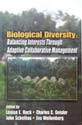
Biological
Diversity: Balancing Interests Through Adaptive Collaborative
Management
Edited by Louise E. Buck, CharlesC. Geisler, John Schelhas,
Eva Wollenberg
 We
live in a world of wide pendulum swings regarding management
policies for protected areas, particularly as they affect
the involvement of local people in management. Such swings
can be polarizing and halt on-the-ground progress. There is
a need to find ways to protect biodiversity while creating
common ground and building management capacity through shared
experiences. Diverse groups need to cooperate to manage forests
in ways that are flexible and can incorporate feedback.
Biological Diversity: Balancing Interests Through Adaptive
Collaborative Management addresses the problem of how
to balance local, national, and global interests in preserving
the earth's biological diversity with competing interests
in the use and exploitation of these natural resources. This
innovative book examines the potential of adaptive collaborative
management (ACM) in reconciling a protected area's competing
demands for biodiversity conservation, local livelihood support,
and broader-based regional development. It clarifies ACM's
emerging characteristics and assesses its suitability for
a variety of protected area situations.
Features :
- Presents a better understanding of an emerging new management
paradigm for balancing interests in biodiversity conservation
and livelihood sustainability
- Provides interdisciplinary analysis and strategies for
success involving social and biological scientists, natural
resource practitioners, policy makers, and citizens
- Includes cases from around the world that illustrate how
effective conservation programs can be developed though
the use of adaptive management and social learning
|
| |
Social
Learning in Community Forests
Editors: Eva Wollenberg, David Edmunds, Louise Buck, Jeff
Fox, Sonja Brodt
 How
can different interest groups engage together in learning
processes that enable them to better manage community forests?
In this volume, practitioners from eight countries document
their experience with the aim of identifying how to characterize
social learning, as well as how to improve upon current practice.
Analysis of current approaches to facilitation and circumstances
or platforms of learning indicate the need for more attention
to the different avenues and styles of learning and the potential
benefits of using multiple avenues. Learning styles and approaches
need to be responsive to stakeholders' preference, culture,
and changes in management needs. Multiple approaches are likely
if the goal is to reach all the necessary parties and to be
relevant to changing condition over time. In documenting these
experiences, the authors link their observations to concepts,
labels, and the theory of social learning to further advance
our general understanding of multi-stakeholder processes in
forest management.
|
|

|
The
Invisible Wand: Adaptive Co-management as an Emergent Strategy
in Complex Bio-economic Systems
Ruitenbeek J, Cartier C. 2001 [May]
This paper provides an economic perspective on concepts related
to adaptive co-management (ACM). The discussion is cast within
a formal generalized complex systems (CS) framework.
We explicitly explore the hypothesis of whether ACM can
be regarded as an emergent strategy under specific conditions.
The conditions draw a corollary from the well-known work of
Adam Smith that describes "self-interest" as a forcing
factor (the "invisible hand") that leads to stability
and efficiency in economic systems. In our construct of a
complex bio-economic system, we postulate that an "altruistic
common interest" can act as a forcing factor (our "Invisible
Wand") that leads to certain dominant emergent strategies
that promote long-term sustainability and human well-being.
One such strategy, we hypothesize, is ACM. A key question
is whether ACM is something that simply evolves naturally
from within a system or whether it is in fact a legitimate
policy intervention that can be imposed or introduced from
the outside.
|
| |
|
|
|
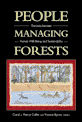
People
Managing Forests: The Link Between Human Well Being and Sustainability*
A co-publication of Resources
for the Future (RFF) and Center
for International Forestry Research (CIFOR)
Carol J. Pierce Colfer and Yvonne Byron, editors
 Confusion
and dismay are rampant among those concerned about human and
environmental issues in the tropics - and with good reason.
Forests are being degraded at apparently ever increasing rates;
and human welfare in forested areas is at best remaining at
a constant level, more often deteriorating. Many - researchers,
environmentalists, policy-makers of various hues - are trying
to address these problems in a variety of ways. This book
represents the evolution of one cooperative effort to understand
and develop mechanisms for dealing with these interrelated
problems, and proposes some conclusions about how to improve
our efforts in the future..
In our research we have asked ourselves this fundamental
question: How can we create conditions that allow local people
who live in and around forests to maintain the valued aspects
of their own way of life and to prosper, while still protecting
those forests on which they, and perhaps the rest of us, depend?
To answer that question, we needed first to identify those
conditions that contribute to the well-being of people living
in forests and, more generally, to sustainable forest management
(SFM). Satisfied that we had a good grasp of the most important
conditions (see below), here we examine their relationship
to sustainability. This examination is the central theme of
this book. Central issues of concern include the identification
and roles of relevant stakeholders (including gender and diversity
issues in Section I and the relevance of a conservation ethic
in Section II), security of intergenerational access to forest
resources (Section III) and rights and responsibilities to
manage forests cooperatively and equitably (Section IV).
|
|
|
 Available
from Resources for the Future
Which Way Forward?
People, Forests, and Policymaking in Indonesia
Carol J. Pierce Colfer
and Ida Aju Pradnja Resosudarmo, editors
"On economic and social justice grounds,
as well as for biodiversity conservation and environmental
management, this is a rare and extremely useful analysis of
forestry issues, given growing domestic and international
concern over the status of Indonesia's forests."
- Larry Fisher, Cornell University
"An original contribution to understanding
the obstacles and opportunities for achieving forest policy
reform in Indonesia and elsewhere."
- Paul K. Gellert, Cornell University
Indonesia contains some of Asia's most biodiverse
and threatened forests. The challenges result from both long-term
management problems and the political, social, and economic
turmoil of the past few years. The contributors to Which Way
Forward? explore recent events in Indonesia, while focusing
on what can be done differently to counter the destruction
of forests due to asset-stripping, corruption, and the absence
of government authority.
Contributors to the book include anthropologists,
economists, foresters, geographers, human ecologists, and
policy analysts. Their concerns include the effects of government
policies on people living in forests, the impact of the economic
crisis on small farmers, links between corporate debt and
the forest sector, and the fires of the late 1990s. By analyzing
the nation's dramatic circumstances, they hope to demonstrate
how Indonesia as well as other developing countries might
handle their challenges to protect biodiversity and other
resources, meet human needs, and deal with political change.
The book includes an afterword by Emil Salim, former Indonesian
Minister of State for Population and the Environment and former
president of the Governing Council of the United Nations Environment
Programme.
Audiencee
A copublication of Resources for the Future,
the Center for International Forestry Research (CIFOR), and
the Institute for Southeast Asian Studies (ISEAS).
Carol J. Pierce Colfer is team leader
of the CIFOR program on Local People, Devolution and Adaptive
Collaborative Management of Forests and coeditor of People
Managing Forests: The Links between Human Well-Being and Sustainability.
Ida Aju Pradnja Resosudarmo is leader
of CIFOR's Underlying Causes of Deforestation, Forest Degradation,
and Changes in Human Welfare program.
|
|
|
'Wild
logging': the rise and fall of logging networks and biodiversity
conservation projects on Sumatra's rainforest frontier..
McCarthy, John F
CIFOR Occasional Paper No. 31, October 2000 in English
During 1999-2000, the illegal and unregulated logging of
Indonesia's forests became the focus of critical attention.
In 2000, as Indonesia's forests continued to rapidly recede,
the problem had become so critical that, without serious changes,
the World Bank and other foreign donors considered withdrawing
entirely from forestry sector projects in Indonesia. While
on a national scale the extent of the problem is now understood,
insufficient attention has been paid to how this 'informal
sector' operates at the district level. The paper is based
on research carried out in the district of South Aceh (Aceh
Selatan) during 1996-1999, before and during the crisis that
marked the end of the Suharto era. Through considering the
emergence of logging networks in this district, this paper
examines the institutional arrangements associated with this
phenomenon, explores how logging networks emerge, how they
operate, and how they respond to economic and political changes
as well as interventions by outside conservation agencies.
|
|
|
Criteria
and Indicators of Sustainability in Community Managed Forest
Landscapes
Bill Ritchie, Cynthia McDougall, Mandy Haggith, Nicolette Burford
de Oliveira
This guide is intended to make a contribution
to the larger efforts worldwide at improving forest management,
human well-being, and the sustainability of natural resources.
In order for it to do so, three important points should be
noted by anyone intending to use the Guide::
- As with any such tool, everything in this guide needs
to be considered in, and adapted to, the local context in
which it is to be used. We consider it not a blueprint,
but a springboard to appropriate action.
- Successful implementation of the approach suggested in
this guide relies on adequate understanding of, commitment
to, and skills in participatory approaches and processes.
This does not mean that only professional participation
practitioners should use it. It means rather that if there
is a lack of any or all of these, this gap should be addressed
prior to and during the C&I processes (for example,
through the readings or contacts suggested in the reference
section).
Furthermore, in relation to point 1 above, as the approach
to CMF C&I and processes for monitoring are adapted
for use locally, it is extremely important that these adaptations
build in and maximize opportunities for shared learning
and ownership of the processes. For example, while the guide
may offer some ideas for structuring CMF C&I, it does
not go in depth into the kinds of participatory tools that
can be best used in different groups to do this. We look
to the implementers of the guide to bring in the participatory
tools and adaptations that will be needed in each context.
We anticipate that across all contexts, this will include
such adaptations as:
- Locally appropriate games to introduce ideass
- Shifting from written word to pictorial representations
or other activities as literacy levels dictate
- Developing strategies to overcome barriers to participation
(such as gender, caste, etc)
- This is a work in progress! CIFOR and collaborators are
continuing work in this area, and we would welcome input
and feedback on this guide.
|
|
|
Self-Governance
and Forest Resources.
Ostrom E
CIFOR Occasional Paper No. 20, February 1999
Forest resources share attributes with many other resource
systems that make difficult their governance and management
in a sustainable, efficient and equitable manner. Destruction
or degradation of forest resources is most likely to occur
in open-access forests where those involved, or external authorities,
have not established effective governance. Conventional theories
applied to forest resources presumed that forest users themselves
were incapable of organising to overcome the temptations to
overharvest. Extensive empirical research, however, has challenged
this theory and illustrated the many ways that forest users
themselves have devised rules that regulate harvesting patterns
so as to ensure the sustainability of forest resources over
time.
|
| |
Abstracts for Proposed Special
IJARGE Issue on Accommodating Multiple Interests in Community-Based
Forest Management
|
|
|
A
Strategic Approach to Multistakeholder Negotiations
David Edmunds and Eva Wollenberg
Center for International Forestry Research (CIFOR)
Environment and development practitioners increasingly are
interested in identifying methods, institutional arrangements
and policy environments that promote negotiations among natural
resource stakeholders leading to collective action and, it
is hoped, sustainable resource management. Yet the implications
of negotiations for disadvantaged groups of people rarely
are critically examined. We draw attention to such implications
by examining different theoretical foundations for multistakeholder
negotiations and linking these to practical problems for disadvantaged
groups. We argue that negotiations based on theories of communicative
rationality and liberal pluralism, which underplay or seek
to neutralize differences among stakeholders, pose considerable
risks for disadvantaged groups. We suggest that negotiations
rooted in the work of radical pluralists and feminist post-structuralists,
which take empowerment as a specific goal and emphasize strategic
behavior and selective alliance-building, promise better outcomes
for disadvantaged groups in most cases, particularly at the
scales and in the historical contexts in which negotiations
over forest management usually take place.
|
| |
Forest
Devolution and Social Capital - State-Civil Society Relations
in the Philippines
Fransisco A. Magno
This paper aims to understand how different stakeholders
affect authority structures in the forest zones. It describes
the general pattern of distribution of power among the state
and forest-dependent communities by taking into account the
constant interplay of forces which cross the public-private
divide. The study analyzes the extent to which local communities,
with the support of civil society organizations, are able
to expand their opportunities to decide the fate of forests
under contemporary laws and policies..
|
| |
Tenure
and Management of Non-State Forests in China since 1950 - A
Historical Review
Liu Dachang
Center for International Forestry Research (CIFOR), Bogor, Indonesia
This article presents a historical review of the tenure arrangements
of non-state forest in China since 1950. It links these tenure
arrangements to different forest management practices and
methods. Where possible, the article also touches on the impacts
of these tenure policies on the distribution of decision-making
authority and benefits, resource growth or depletion, and
incentives for investment in forests.
|
| |
The
Prehistory of Community Forestry
Ramachandra Guha
Center for International Forestry Research (CIFOR), Bogor, Indonesia
The history of state forestry has indeed been a history of
social conflict. On the one side are the professional foresters
who believe that timber production can be ensured only through
the exclusion of humans and their animals from wooded areas;
on the other, the peasants, pastoralists, charcoal ironmakers,
basketweavers and other such groups for whom access to forests
and forest resources is crucial to economic survival. To the
criticisms of these latter groups have now been added the
criticisms of environmentalists, who charge foresters with
simplifying complex ecosytems in the direction of commercially
valuable but biologically impoverished monocultures.
|
| |
Changing
Policies and the Persistence of Patron - Client Relations -
An Analysis of Stakeholders' Responses to Changes in Forest
Policies
Y.B. Malla
In 1978, following two decades in which all forest resources
were nationalised, the government of Nepal in 1978 introduced
a policy for community forestry that promised to hand over
most accessible forests to communities for protection and
management (HMGN, 1989). Some recent assessments of the impact
of community forestry policy implementation have shown mixed
results. I would suggest that the limited and, in some places,
negative impact of community forestry policy in Nepal can
be explained by looking at the relationships among different
individuals, groups of people and organisations and institutions,
generally referred to in this paper as stakeholders, who have
interests in forest resources.
|
| |



 Home | ACM Selected Publications
| Link to CIFOR Publications


 For more information about publications, please click