
To assist you with your travel arrangement and preparation to attend this learning exchange, please read the summary program and the travel information menu above. Kindly read this information carefully and send us your personal information.

Sumatra
About Sumatra
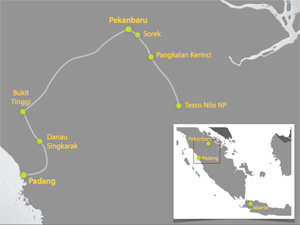
Sumatra (Indonesian: Sumatera) is an island in western Indonesia. It is the largest island entirely in Indonesia (two larger islands, Borneo and New Guinea, are shared between Indonesia and other countries) and the sixth largest island in the world at 473,481 km2 with a population of 50,365,538. The Sumatra region consists of 10 provinces; in this learning exchange, we will visit two — West Sumatra and Riau.
The longest axis of the island runs approximately 1,790 km (1,110 mi) northwest–southeast, crossing the equator near the centre. At its widest point, the island spans 435 km (270 mi). The interior of the island is dominated by two geographical regions: the Bukit Barisan or Barisan Mountains stretching end to end along the island in the west, and the swampy plains found in the east.
Sumatra is the world's fifth highest island, and the third highest in the Indonesian archipelago. The backbone of the island is the Barisan Mountain chain, with the active volcano Mount Kerinci as the highest point at 3,805 m (12,467 ft), located at about the midpoint of the range. There are 35 active volcanoes in Bukit Barisan. Volcanic activity has endowed the region with fertile land and beautiful sceneries. It also contains deposits of coal and gold. Sumatra's volcanos are part of the Pacific "Ring of Fire" — which is also the reason why Sumatra has had some of the most powerful earthquakes ever recorded.

To the east, big rivers carry silt from the mountains, forming the vast lowland interspersed by swamps. Although the area is mostly unsuitable for farming, it is of great economic importance for Indonesia as it produces oil from both above and below ground — palm oil and petroleum.
Sumatra is also the largest producer of Indonesian coffee. Smallholders grow Arabica coffee (Coffea arabica) in the highlands, while Robusta (Coffea canephora) is grown in the lowlands. Most of Sumatra was once covered by tropical rainforest, but economic development coupled with corruption and illegal logging has severely threatened its existence. Even designated conservation areas have not been spared.
The island has more than 10 national parks, including three which are listed as the Tropical Rainforest Heritage of Sumatra World Heritage Site — Gunung Leuser National Park, Kerinci Seblat National Park and Bukit Barisan Selatan National Park. Sumatra's Berbak National Park is one of three national parks in Indonesia listed as a wetland of international importance under the Ramsar Convention.
Sumatra supports a wide range of vegetation types, including 17 endemic genera of plants, which are home to a rich variety of species. Unique species include the Sumatran Pine, which dominates the Sumatran tropical pine forests of the higher mountainsides in the north of the island, and rainforest plants such as Rafflesia arnoldii (the world's largest individual flower), and the Titan Arum (the world's largest unbranched inflorescence).
The island is home to 201 mammal species and 580 bird species. There are nine endemic mammal species on mainland Sumatra and 14 more endemic to the nearby Mentawai Islands. Species include: Sumatran Tiger, Sumatran Orangutan, Sumatran Rhinoceros, Sumatran Elephant, Sumatran Striped Rabbit, Dhole, Dayak Fruit Bat, Malayan Tapir, Malayan Sun Bear and the Bornean Clouded Leopard.
The island has lost 48 percent of its natural forest cover since 1985, and many of the remaining species are endangered. The Sumatran Tiger, Sumatran Rhino, and Sumatran Orangutan are all Critically Endangered, indicating the highest level of threat to their survival.
Sumatra is not very densely populated, with about 96 people per km2 — more than 45 million people in total. Many different ethnic groups are represented here, speaking 52 different languages. A majority of people in Sumatra are Muslims (87 percent), while 10 percent are Christians, 2 percent are Buddhist and 1 percent are Hindu.
West Sumatra
West Sumatra (Indonesian: Sumatera Barat, abbreviated to Sumbar) is a province of Indonesia. It lies on the west coast of the island Sumatra. It borders the provinces of North Sumatra (Sumatera Utara) to the north, Riau and Jambi to the east, and Bengkulu to the southeast. It includes the Mentawai Islands off the coast. The capital of the province is Padang.

West Sumatra has an area of 42,130.82 km² and a growing population — from 2.8 million in 1971, to 4.8 million in 2010. Geographic features include plains, mountainous volcanic highlands formed by the Barisan mountain range that runs from north-west to south-east, and an offshore island archipelago called the Mentawai Islands. The lakes of West Sumatra include: Maninjau, Singkarak, Diatas, Dibawah, Talang. The rivers of West Sumatra include: Kuranji, Anai, Ombilin, Suliki, Agam, Sinamar, and Arau. The mountains and volcanoes of West Sumatra include: Marapi (2,891 m), Sago (2,271 m), Singgalang (2,877 m), Talakmau (2,912 m), Talang (2,572 m), and Tandikat (2,438 m).
The history of West Sumatra is related to the history of the Minangkabau people. The Minangkabau ethnic group (also known as Minang) is indigenous to the highlands of West Sumatra. Their culture is matrilineal, with property and land passing down from mother to daughter, while religious and political affairs are the responsibility of men (although some women also play important roles in these areas).

The name Minangkabau is thought to be a conjunction of two words, minang ("victorious") and kabau ("buffalo"). There is a legend that the name is derived from a territorial dispute between the Minangkabau and a neighbouring prince. To avoid a battle, the local people proposed a fight to the death between two water buffalo to settle the dispute. The prince agreed and chose the largest, most aggressive buffalo he could find. The Minangkabau chose a hungry baby buffalo with its small horns ground to be as sharp as knives. Seeing the adult buffalo across the field, the baby ran forward, hoping for milk. The big buffalo saw no threat in the baby buffalo and paid no attention to it, looking around for a worthy opponent. But when the baby thrust his head under the big bull's belly, looking for an udder, the sharpened horns punctured and killed the bull, and the Minangkabau won the contest and the dispute. The roofline of traditional houses in West Sumatra, called Rumah Gadang (Minangkabau: "big house"), curve upward from the middle and end in points, in imitation of the water buffalo's upward-curving horns.

Lake Singkarak (Indonesian: Danau Singkarak) is a lake in West Sumatra, Indonesia, located between the cities of Padang Panjang and Solok. It has an area of 107.8 km², being approximately 21 km long and 7 km wide. The natural outlet for excess water is the Ombilin River which flows eastward to the Strait of Malacca. However, a hydroelectric project has diverted most of the lake outflow to the Anai River, which flows westward into the Indian Ocean near Padang. This Singkarak power station uses the water to generate power for the West Sumatra and Riau provinces. A species of fish called ikan bilih (Mystacoleucus padangensis) is endemic to the lake, and is harvested for human consumption. A railway line, which connects Padang and Sawahlunto-Sijunjung, skirts the length of the lake on the eastern side.

Riau
Riau is located in the centre of Sumatra along the Strait of Malacca. Riau is one of the richest provinces in Indonesia because of its many natural resources, particularly petroleum, natural gas, rubber, palm oil and fibre plantations. However, extensive logging has led to massive decline in forest cover from 78 percent in 1982 to only 33 percent in 2005.
The economy of Riau expanded faster (8.66 percent in 2006) than the Indonesian average (6.04 percent in 2006). This is largely a resource-based economy, including crude oil (600,000 bpd), palm oil and other forest products. Local government income benefits from a greater share of revenue tax (mainly crude oil) due to the decentralisation law of 2004.
Since the 1970s, most of Indonesia has been experiencing declining population growth rates. Riau has been a significant exception, with increasing rates every decade since 1970 to a 4.35 percent annual rise for the 1990s. As of the 2010 census, the provincial population is 5,543,031.
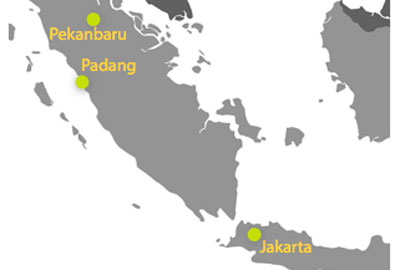
Riau is home to various dialects of the Malay and Chinese language. The dominant language used by the Malay population is Riau Malay, on which the national language, Indonesian, is based.
Pekanbaru, the provincial capital of Riau and its largest city, has an area of 632.26 km² and a population of 903,902. It is located by the Siak River, which drains to the Strait of Malacca. Pekanbaru has direct access to the busy strait and was long known as a trading port (the city name is derived from the Indonesian words "pekan" meaning 'market' or 'town', and "baru" meaning 'new').
Tesso Nilo National Park
Tesso Nilo National Park is a national park in Riau Province, Sumatra, Indonesia. It was declared a national park by the Indonesian Government in 2004. The original area of the park was 385.76 km², but the decision has been made to expand it to 1,000 km². Tesso Nilo National Park houses some of the largest lowland rainforests remaining on Sumatra. The Center for Biodiversity Management has surveyed over 1,800 plots in tropical forests around the world. They found that no other site has as many vascular plants as Tesso Nilo. The Indonesian Institute of Sciences (LIPI) also surveyed forests throughout Sumatra, and found that Tesso Nilo housed by far the most species.
Flora and fauna
Endangered Sumatran Elephants and critically endangered Sumatran Tigers and Sumatran Orangutans live here.
Conservation and threats
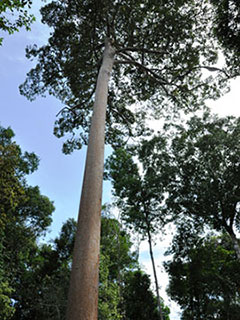
The park suffers from heavy encroachment by illegal loggers and illegal settlers who clear the park for crops and palm oil plantations, as well as village sites. Already, 28,600 hectares, or about a third of the park, has been deforested. Even when the park was being established, wood was delivered illegally to Indah Kiat paper mill. The paper industry firm that owns the paper mill received millions of US dollars from European credit agencies, including the German Hermes. In November 2009, WWF announced that the park had finally been expanded by 44,492 hectares but encroachment still remains a serious problem. During drought periods, the forest is susceptible to wildfires. In the October 2006 fires, 1 km² of the park was burnt. According to a 2009 WWF survey, the population of Sumatran elephants had reached 200 in the park, and around 350 elephants in Riau Province.
Flying Squad Elephant Patrol
WWF is running a successful human–elephant conflict mitigation operation called Flying Squad at one site on the border of Tesso Nilo National Park and has been able to convince three companies to adopt its approach. Ready to move out at the shortest notice and drive wild elephants back into the national park, the Flying Squad brings short-term relief to the intense conflict between local communities and wild Sumatran elephants by preventing them from feeding on crops and plantations grown in the villages. See more on WWF’s Flying Squad and Sumatran elephant.
PT MUSIM MAS
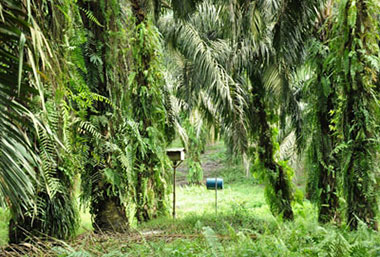
Established in 1972, PT Musim Mas has rapidly expanded into a large, fully integrated palm oil corporation. Musim Mas has a diverse portfolio of products and assets, but its core business is palm cultivation and palm oil processing. It is a market leader in the manufacturing of palm oil, soap and margarine, and owns one of the largest palm oil refineries in the world. Indonesia is the company's native market and Musim Mas ranks among the biggest Indonesian producers in the vegetable oil refining and soap manufacturing industries.
Sources:
http://www.savesumatra.org/index.php/wherewework/detail_location/7
http://en.wikipedia.org/wiki/Tesso_Nilo_National_Park
http://en.wikipedia.org/wiki/Sumatra
http://en.wikipedia.org/wiki/West_Sumatra
http://en.wikipedia.org/wiki/Lake_Singkarak
http://en.wikipedia.org/wiki/Riau
http://en.wikipedia.org/wiki/Pekanbaru
http://www.musimmas.com