| |
 | |
|
|
|
Collaborative forest management of teak forest in Central Java RESEARCH ACTIVITIES Steps of implementation of Java case study:
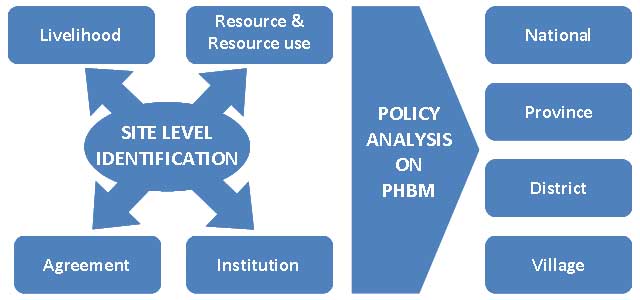
Phase 1 - BASELINE STUDY Year 1 process
Phase 2- INTERVENTION Year 2 process
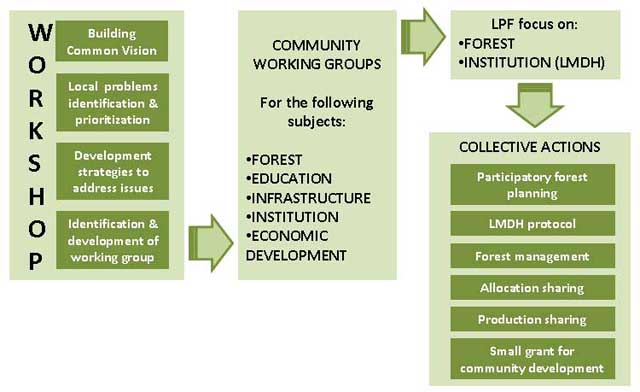
The eight main activities are as follows: 1. Building Awareness of the Community Members at the Village Level about LPF Project This is an ongoing activity which started when the project selected the villages. In Year 1, we conducted several activities and collected data and information about the village and its stakeholders, resources and resource use, institutions, livelihoods, formal and informal agreements and policy framework, in order to get a better picture about the study area. While in Year 2, the project developed a framework to guide activities in the intervention phase. Prior to our intervention in each village, it was necessary for the project team member to introduce the project to community members. The awareness raising program was conducted during some local formal and informal meetings, such as pengajian (religious activity), arisan (gathering), etc. 2. Building a Common Vision Different stakeholders have different interests and perspectives, which may directlt or indirectly lead to conflicts in the future about their access to renewable resources. Previous studies showed that people, who at the moment have different interests and possibly are facing conflict, may have a common vision regarding the ideal conditions of the future, e.g. the next 15 to 20 years. Based on these studies, we facilitated the community members to come up with a common vision for the village. The community then came up with a draft of their common vision, which was later on revealed and recognized by village stakeholders. 3. Identification of Problems and Priorities After formalising the common vision, the local community identified the current problems that hindered them from achieving the vision. Those problems were subsequently prioritised, such as which ones were short-term or long-term problems to address. They were also clustered based on sectors, such as agriculture, forestry, education, infrastructure, etc. 4. Development of Strategy to Address Local Issues The community was facilitated to develop a strategy to address the prioritised problems. 5. Building Community Working Groups Each strategy was developed further in each working groups. Community members voluntarily assigned themselves to their sector of interest, and selected the coordinators of the working groups. 6. Facilitating Collective Action This is the coordination work carried out by each community working group in addressing local issues through - what the project called – a micro project. We facilitated those working groups, both those who are working on forestry issues and non-forestry issues through discussion, focus group discussions, and workshops. 7. Coordination and Communication At this step, the project facilitates stakeholders at different levels; assists the coordination and improves communication among them particularly on the collaborative forest management or PHBM scheme. 8. Capacity Building The project builds the capacity of the people by conducting training and discussion sessions based on the needs of local community. These empower the local community, in particular forest farmers. Intervention steps, methodology and tools used
Phase 3 – MONITORING AND EVALUATION The performance of the LPF project was participatory evaluated by project’s stakeholders in its final year of implementation. Evaluations were considered essential for identifying the results and lesson learnt of LPF project implementation between 2004 and 2007. LPF performance evaluations took place at the village level and at project level. Village level performance evaluation was involved all village stakeholders in forest management, while project level performance evaluation involved the project team member. The objectives were:
Further information click Java Case Study Report on Participatory Evaluation & Self Assessment
|