

Forests play central roles in the livelihoods and adaptation of local communities (providing 80% of household energy and 70% of women’s income ). However goods and services provided by forests and their contributions to adaptation (commonly referred to as Ecosystem Based Adaptation or EbA) are poorly integrated in national adaptation plans and policies. Policy makers in many parts of Africa have referred to the lack of specific tools to integrate and mainstream forests into national adaptation plans and policies. To address this, CIFOR began looking for specific tools that allow evidence based decision-making and help policy makers to consider forest ecosystem services in adaptation plans and policies. The already existing CRiSTAL (Community-based Risk Screening Tool – Adaptation and Livelihoods) tool (WEBPAGE) was identified as promising but not specifically adapted to the context of forest-dependent communities. Joining their efforts, CIFOR, IISD and the C3D+ network decided to adapt CRiSTAL to the forest context. The CRiSTAL Forest tool was born.
CRiSTAL Forests helps users to analyze and plan adaptation strategies that consider:
- How current climate hazards affect a project area, its forests, ecosystem services and local livelihoods, and what effects potential future climate hazards could have
- Which ecosystem services are most affected by current climate hazards and which are most important for response strategies
- How communities respond to the current and potential direct and indirect impacts of these climate hazards
- What the role of forests is in those coping and adapting strategies.
CRiSTAL Forests helps users to readjust adaptation projects by evaluating:
- How development and/or conservation project interventions affect access to, or availability of, critical ecosystem services
- What project adjustments (revision of existing activities and/or design of new activities) could be made to support climate adaptation and reduce climate risks.
CRiSTAL Forests helps users to identify and plan mitigation activities and projects that consider:
- The potential of development and/or conservation interventions to reduce greenhouse gas emissions and participate in REDD+ schemes.
CRiSTAL Forests outputs include:
- Sensitivity of ecosystem services to climatic events
- Sensitivity of livelihoods to climate and other stressors
- Adapting and coping strategies
- Adjustments measures for existing adaptation projects
- Potential mitigation activities.
Tool structure

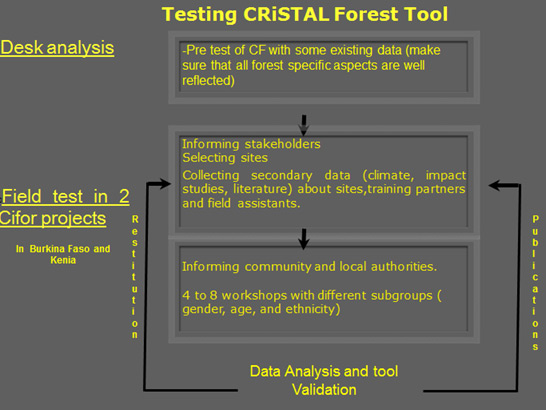
The field testing phase in CIFOR adaptation projects
The CRiSTAL Forests project was split into two phases consisting of a scientific review and in field testing to adapt the existing CRiSTAL tool to forest-dependent communities. The aim of the project is to provide policy makers, development agencies and NGO’s in the forestry sector with a forest-specific climate change assessment tool.
Seeking synergies between projects: CRiSTAL Forests , ACFAO in West Africa and AdaptEA in East Africa
CRiSTAL Forests was tested on two projects, which allowed for testing in several contexts with groups in Burkina Faso and Kenya. The different modules of the tool were applied to analyze the impacts of climate change on livelihoods and ecosystem services as well as to identify coping and adapting strategies within communities. The two projects identified were:
- ACFAO: Forest and Adaptation to Climate Change in West Africa
ACFAO is a three year CIFOR-led adaptation project (2011-2014), implemented in Burkina Faso and Mali, and funded by the French Global Environment Facility (FFEM).Overall objective of the ACFAO project
The objective of the project is to mainstream EbA in policies and projects to enhance the sustainable management of forests and to improve adaptive capacity of the most vulnerable rural people through provision of forest services. The project aims to contribute to the development of policies and adaptation projects(specifically Projects Based on the Ecosystems, ABE) at different scales (local, national and regional) in West African savannahs.Specific objectives
- Analyze policies (forest, adaptation and their linkages) and identify opportunities of influencing these policies by implying regional, national and local actors in this analysis.
- Analyze with a participative, inter-scale and integrative approach the current and future vulnerability of the communities in pilot sites, by focusing on the links between ecosystems dynamics and reduction of the vulnerability.
- Formulate adaptation strategies taking into account the ecosystem services by facilitating the local strategies designed by the communities and decision makers and by analyzing their implementation.
- Inform the actors involved in the project and reinforce their capacities (political decision makers, experts and local actors),
- Disseminate information and create networks of relevant actors within climate change adaptation and ecosystem services in dry areas, both in and out of the countries where the project is implemented.
- AdaptEA: Adaptation of People to Climate Change in East Africa: Forest and tree-based ecosystem services, risk reduction and human well-being.
AdaptEA is a 4-year (2011-2015) Rockefeller Foundation-funded project, being implemented in the Afromontane region of Mt.Elgon, spanning the borders of Kenya and Uganda. This project is a collaboration between Makerere University, Kenya Forestry Research Institute (KEFRI), and the World Agroforestry Center.Project Summary
Climate change will challenge the resilience of both agriculture-based livelihoods and natural resource management regimes in East Africa in a myriad of ways. A major challenge is to reduce the vulnerability of people and climate-sensitive sectors, including water, agriculture and energy, to today’s climate variability and to ensure that future development activities are appropriate to future climate contexts. Through an EbA research approach, this project will help to inform rural stakeholders and national policy makers in East Africa regarding the sustainability of different adaptation strategies. The research will integrate a review of the climate change adaptation policy contexts, with local level analyses of stakeholder vulnerability and forest governance, and modeling of forest and tree-based ecosystem services in promoting resilience of agriculture production. Based on these research outputs, a participatory approach will be used to develop effective adaptation strategies targeted at different local and national stakeholder groups.Project objectives:- To analyze national and international policies on climate change adaptation, ecosystem goods and services provided by forests and trees, and roles of stakeholders in the national arena.
- To assess current and future vulnerability of communities with a focus on roles of ecosystem services provided by forests and trees.
- To assess the roles of ecosystem regulating services (e.g. hydrology and microclimates) of forests and trees in promoting resilience of agriculture.
- To develop and disseminate recommendations for policies and approaches linking forests and trees to agricultural adaptation to climate change.