

More and more PEN doctors!
CONTENT:
- PEN updates: data submissions, newly defended dissertations, publications and an update on the IUFRO World Congress coming up
- Main story: PEN @ the Smallholder and community forestry meeting in Montpellier, France
- PEN project: Mariève Pouliot in Burkina Faso: Forest and environmental dependence around Kaboré Tambi National Park
- Good reading: Market drives non-timber forest product commercialisation and specialisation
- PENroach dispatch 7: Collaborative writing tools
-
- Data submission: 37 PEN datasets have been submitted, 27 have or will soon be approved. The rest are undergoing review.
- Congratulations to 3 new PEN doctors: Øystein, Santosh and Shiba!
Øystein Juul Nielsen at University of Copenhagen in Denmark defended his dissertation, Rural livelihoods, coping strategies and forests in Mozambique on 23 February.
Santosh Rayamajhi at University of Copenhagen in Denmark defended his dissertation, Forest dependency, livelihoods and conservation of high altitude forests in Nepal on 25 February.
Shiba Kar at Pennsylvania State University in the United States defended his dissertation, Non-timber forest products utilization and livelihood development in Bangladesh on 3 March.
- PEN publications on the web: We have a growing list of PEN partner publications that use PEN data on our website. This includes peer-reviewed journal articles, books and book chapters, working papers and reports. Let us know about other PEN-related publications we can add to the list.
- IUFRO World Congress, 23–28 August 2010, Seoul, South Korea: We will host a panel, ‘Global comparative analysis of local incomes from the forests’as part of session H.03, ‘Forests, communities and cultures’. Twelve PEN Partners have been selected to present their case-study results in the context of the emerging global results. Congratulations to those selected, and best of luck securing the funding to attend! For more information about the Congress go to http://www.iufro2010.com/
2. PEN @ the Smallholder and community forestry meeting
Last month (24–26 March 2010), researchers, policy makers and practitioners working on smallholder and community forestry met in Montpellier, France, to share and evaluate global patterns in forest use and management by smallholders and community groups in order to outline the current state of knowledge and identify future research areas. You can find about more about the conference here: https://www2.cifor.org/event/taking-stock-of-smallholder-and-community-forestry-where-do-we-go-from-here/.
The PEN community was present at the meeting with two oral presentations, two poster displays and a booth. The first oral presentation, ‘Rural development potential of community forestry in Nepal’, was made by PEN partner Bir Bahadur Khanal Chhetri, a doctoral candidate at the Faculty of Life Sciences, University of Copenhagen. His study found that income and expenditure were highly skewed towards a few well-off community forest user groups (CFUGs), and that CFUG income depended on group size and market access. CFUG expenditure patterns are shaped by income, management costs, and socio-political and contextual factors, such as gender and caste representation in the CFUG executive committee and the political-administrative boundaries.
Amy Duchelle made the second oral presentation. She recently received her doctorate from the University of Florida, and is currently at the Universidade Federal do Acre, Brazil, and working as a consultant with CIFOR. The paper, jointly authored with PEN partner Angelica Almeyda (amongst others), investigates the livelihoods and forest clearing in community-managed forests in an Amazonian tri-national frontier. The study found extremely high forest cover and forest income dependence in communities in MAP region that produce Brazil nuts. They noted that the negative relationship between Brazil nut income and forest clearing in Pando and Madre de Dios regions reinforced the need to bolster the Brazil nut sector to promote regional forest-based livelihoods and conservation.
PEN Research fellow and data guru Ronnie Babigumira was PEN’s information resource, stationed at the PEN booth where he displayed 2 PEN posters: ‘Money does not grow on trees, but can trees help the poor grow out of poverty?, and PEN partner Nick Hogarth’s, ‘Bamboo, poverty and rural economic development in Guangxi Province, China’.
3. PEN project: Mariève Pouliot in Burkina Faso: Forest and environmental dependence around Kaboré Tambi National Park
This study was conducted in the region bordering the Kaboré Tambi National Park in the south-central part of Burkina Faso. The park is situated approximately 100 km south of Ouagadougou and covers 155 000 ha. Nine villages surrounding the park were surveyed, and 298 households completed the year-long PEN survey in October 2008. Land cover in the park mainly consists of open forest with patches of savannah. It has been a classified area since 1976, when people lost their access rights and a strategy of pure conservation was adopted. Even though the harvesting of non-timber forest products is strictly regulated, people often penetrate the park illegally to harvest fuelwood, wild foods, construction materials, medicinal plants and fodder. The landscape outside the park mainly consists of savannah, fallow and parklands, and thus consists of another source of wild products for local communities.
Overall, forest and other, non-forest environmental income contributes respectively 8.6 and 18.3 % to household income. While forest dependence does not vary systematically with total household income, environmental dependence shows a significant decrease with income (Figure 1). Very poor households depend on the environment for as much as 28% of their total income, whereas environmental income constitutes 9.4% of the income of less poor households.
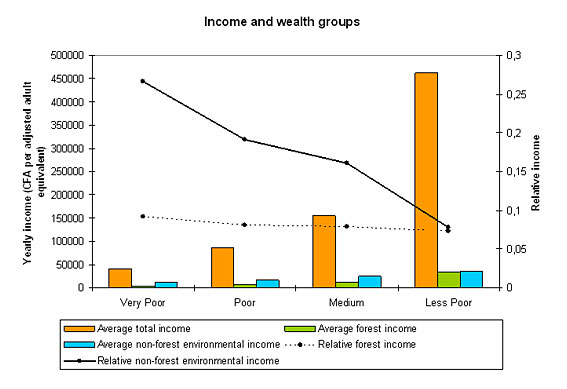
Figure 1. Burkina Faso and income quartiles, 2007–2008
When combined, forest and environmental income ranks as the second biggest contributor to household income in the study area, just after livestock income (35%). For all 4 wealth groups, forest and environmental income contribute to total household income with a higher share than agricultural incomes, which is on average 22%. Although business contributes 10% to total income, wages and other sources (e.g. pension and remittances) only represent 2% and 4%, respectively.
Fuelwood is the most important product collected from the wild: It accounts for 28% of household environmental and forest income on average. Fruits and nuts from V. paradoxa (shea – see Figure 2) are the second most economically important wild product in the survey area (21%). Grass for roof thatching is another important non-timber forest product in the region, contributing 14% of household environmental and forest income. While fuelwood and thatching grass are mostly used for subsistence at the household level (86% and 84%), shea nuts and fruits mainly are a source of cash income (66%).
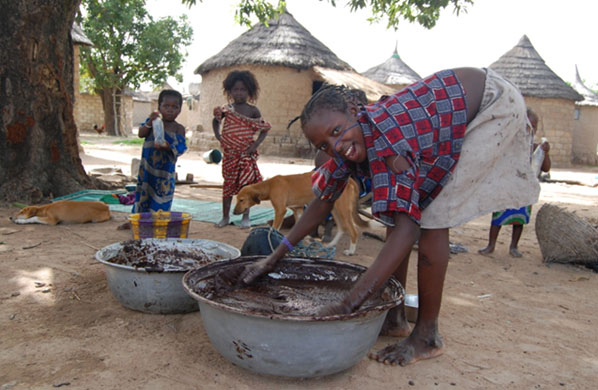
Figure 2. Girl making shea butter
Seasonality of income was found to be associated mostly with crop income, and all other sources of income were relatively stable around the year. Thus, there was no indication that environmental income was filling gaps during the lean times during this study.
4. Good reading: Markets drive non-timber forest product commercialisation and specialisation
CIFOR’s global comparative project on commercialisation and specialisation of non-timber forest products was a forerunner to PEN. A major conclusion from 61 case studies was that ‘commercial trade drives a process of intensified production and household specialisation among forest peoples’. In addition to markets, local institutions, resource abundance and level of development were important factor to explain change. The study concluded, ‘some of the best income-earning opportunities lie in intensified systems that mark a transition from gathering to cultivating and that work to overcome the problem of resource depletion’.
The project also provided a simple and therefore useful 2-dimensional classification of the case studies, which can be extended to household level analysis. The classification is based on
- Share of income – the products’ contribution to the local economy
- Cash income share – integration into the market economy.
Two major publications from the project are:
- Ruiz-Pérez, M., et al. 2004 Markets drive the specialization strategies of forest peoples. Ecology and Society 9(2).
- Belcher, B., Ruíz-Pérez, M. and Achdiawan, R. 2005 Global patterns and trends in the use and management of commercial NTFPs: Implications for livelihoods and conservation. World Development 33(9):1435-1452.
Contact Nick Hogarth (n.hogarth@cgiar.org) or Ronnie Babigumira (r.babigumira@cgiar.org) for more information about the articles.
5. Collaborative writing tools
In principle, collaborative writing is an excellent idea. Diverse ideas, backgrounds and styles of the collaborators should result in a richer and better piece of work. In practice however, the process can be quite stressful as the lead author tries to herd everyone into the same … pen. In time and with tenacity on the part of the lead author, or pressure from the editor, a final draft inevitably emerges. This is where collaborative writing tools come in. They can make editing and reviewing documents by several individuals easier, simultaneously or in sequence.
The idea is intuitive, right? Instead of having multiple versions of one draft making the rounds (and sometimes multiple drafts) , why don’t we have one master draft reside in a central place accessible to all. The draft can reside on a network server for centralised organisations or on the web for authors in different places. So I thought, but whenever I have tried to use such a platform, no one edited the live document. Instead, we quickly reverted to the tried, tested and tiresome email-attachments route. I never asked why, but I am guessing I didn’t do a good job of selling the technology.
For this PENroach dispatch, I am encouraging greater use of these collaborative writing tools. In my view, the most important features are the ability to track changes, add comments, keep the document private, and carry out a spell check. I have used and highly recommend Google docs (it has all the features I consider important). However, there are more solutions available. Thankfully, Kolabora has reviewed and compiled a comprehensive list to help you get started.
Happy Collaborating.
This dispatch was inspired by a recent column by Bibi, the alter ego of Sufiet Erlita, our Information Officer in the Data and Information Management Unit.
Arild Angelsen, PEN coordinator, arild.angelsen@umb.no
Ronnie Babigumira, PEN Research Fellow, r.babigumira@cgiar.org
Nick Hogarth, PEN partner and consultant, n.hogarth@cgiar.org


