

PEN side event at World Forestry Congress in Buenos Aires
Contents:
- PEN updates
Data submissions, new PEN doctor, PEN publications now on the web. - The main story
PEN side event at World Forestry Congress in Buenos Aires - PEN project 1
Abebe Seifu: Forest income and rural livelihoods in Ethiopia’s central highlands - PEN project 2
Yemiru Tesfaye: Forest income & poverty alleviation in participatory forest management in the Bale Mountains, Southern Ethiopia - Good reading
Realising REDD+: National Strategy and Policy Options - PENroach dispatch 6
Google Search: uncovering the hidden gems - Welcome tiger!
- Data submission: 35 datasets have now been submitted, 25 have or will soon be approved. The rest are undergoing checking.
- Another new PEN doctor: Amy Duchelle (University of Florida, USA) has just defended her dissertation titled “Conservation and Livelihood Development in Brazil Nut-Producing Communities in a Tri-National Amazonian Frontier.” Congratulations Amy!
- PEN Publications on the web: We now have all PEN Partner publications that use PEN data on the CIFOR-PEN website. This includes peer-reviewed journal articles, books and book chapters, working papers and reports. Go to here, and please let us know of any other PEN related publications that need to be added.
- IUFRO World Congress, 23-28 August 2010, Seoul, Korea: PEN is planning to host a panel called Global comparative analysis of local incomes from the forests as part of session H.03 ‘Forests, Communities and Cultures’. We are currently in the process of selecting four PEN partners to participate in the panel, to present their case-study results in the context of the emerging global results. For more information go to http://www.iufro2010.com/
2. PEN side event at World Forestry Congress in Buenos Aires
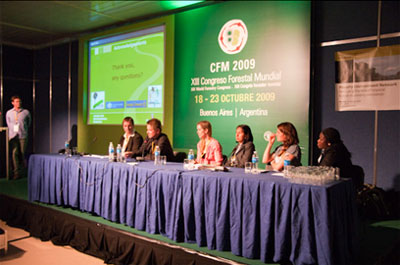
(left to right) PEN panel participants: Nick Hogarth taking questions, Carsten Smith-Hall, Sven Wunder, Amy Duchelle, Patricia Uberhuaga, Mariève Pouliot and Beatrice Darko Obiri.
PEN held a side event on Monday evening, 19 October 2009, at the 13th World Forestry Congress, Buenos Aires, Argentina. ‘Assessing the role of tropical forests in poverty alleviation’ was hosted by the Faculty of Life Sciences at the University of Copenhagen in coordination with CIFOR. The side event featured five case studies from PEN partners who carried out the studies. This was the first dedicated PEN side event at an international meeting to present preliminary results from the ongoing global analyses.
Professor Carsten Smith-Hall from the University of Copenhagen, Denmark, gave the welcome presentation which provided an overview of the side event and an introduction to the presentations to follow. Dr Sven Wunder from CIFOR’s Brazil office then gave an introduction and overview providing background to the PEN Project, an update on the status of the project and some preliminary results from 20 of the 40 expected case studies (see figure).

Five case study presentations followed, giving the audience insight into the variety of the individual data sets that make up the global results. Each of the five case studies presented some standardised key results, making comparison between the cases easy. They were:
- Average forest income share
- Absolute and relative forest income share according to income quintiles (i.e., forest dependency)
- The main sources of forest income, and contributions of cash compared to non-cash sources (subsistence and environmental income)
The presentations were:
- Forest income and dependency in Guangxi Province, China, by Nick Hogarth of Charles Darwin University, Australia. (Powerpoint presentation, 3.8 MB)
- Forest income and economic dependency on forest resources in the Bolivian lowlands, by Patricia Uberhuaga from the University of Copenhagen, Denmark. (Powerpoint presentation, 3.3 MB)
- Forest dependency in the Brazilian and Bolivian Amazon, by Dr Amy Duchelle, University of Florida, USA; Universidade Federal do Acre, Brazil. (Powerpoint presentation, 3.3 MB)
- Do forests contribute to rural livelihoods in Ghana? By Beatrice Darko Obiri, Forestry Research Institute of Ghana. (Powerpoint presentation, 2.1 MB)
- Environment-Poverty linkages in West Africa: Household dependence on renewable natural resources in Burkina Faso, by Mariève Pouliot, University of Copenhagen, Denmark. (Powerpoint presentation, 4.9 MB)
Following the presentations there was some engaging questions from the floor and positive reaction to the emerging global results as well as to the streamlined format and comparable results presented for each case study.
‘I think, and hope that all this hard work will be justified in the way that DFID and other agencies will increase the resource flows to the [forest] sector in the future, and I think this work will be invaluable in setting the picture for that,’ said a DFID representative, one of PEN’s funders.
The side event was captured on film. Several PEN Partners attending the World Forestry Congress were interviewed about their PEN research experience for use in an upcoming video about PEN. In a separate exercise, Ronnie Babigumira presented a PEN poster: ‘Money does not grow on trees, but can trees help the poor grow out of poverty?’ The poster highlights the current status of the project and some preliminary global results.
Thanks to Amy Duchelle and Nick Hogarth for co-organising the event, Carsten Smith-Hall and Sven Wunder, Ronnie Babigumira and all the PEN partner panellists to contributing to the successful event.
3. PEN project 1: Abebe Seifu (abebse@umb.no)
Forest income and rural livelihoods in Ethiopia’s central highlands
This PEN study was conducted in the Shashemene Forest Industry Enterprise (SFIE) forest in the central highlands of Ethiopia. Located 250 kilometers from the capital city of Addis Ababa, the forest covers 21 000 hectares. Natural forest covers 15 000 hectares and plantation covers 6000 hectares. The SFIE has the mandate to conserve the natural forest while generating income from the plantation. Six villages at the forest frontier were surveyed; 224 households completed the year-long PEN survey in May 2008.
On average, forest income contributes 23% of a household’s total net income (cash and subsistence) but the average percentage across income quintiles varies. Overall, forest use expressed as relative forest income (proportion of forest income over average income) decreased as total average income increased (Figure 1). While forest income represents 0.36 for the lowest quintile, the contribution drops to 0.21 for the highest quintile. This implies the poorest segment depends more on forest income than the better off. Forest use expressed in absolute forest income increased along with higher income quintiles. The highest quintile derives about four times larger absolute forest income (79 USD) than the lowest quintile (20 USD). This implies the better-off households draw more income from forests than the poorest households.
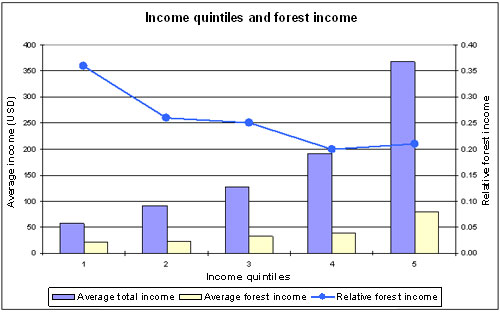
Figure 1. RFI and income quintiles for households in SFIE, Ethiopia, 2007–2008
Forest income ranked as the second biggest contributor to household income next to agricultural income (44%), and the third cash income source (15%) after crop (43%) and wage (18%). Fuel wood (72%) is the most important source of forest income; a distant second rank are timber poles (11%). Conversely, poles are more important in cash generation (71%) than fuel wood (21%). Seasonality of income is more evident for crop than other income sources.
Although the share of wage (6%) and business income (4%) are small for the total household income, these sources account for a significant proportion of cash income. Combined together the cash contribution increase to 30%. These sources are highly related to the activities of SFIE, which employs household members to plant, log, and guard. Branch offices of the SFIE boost the formation of business centres, which are important for rural livelihood diversification.
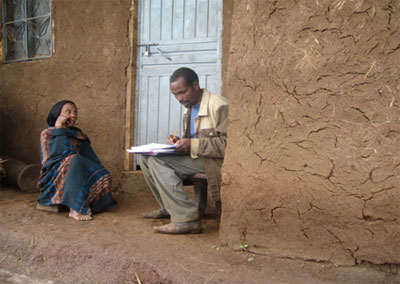
Interview with a female head of household
In this study, the main role of the forest is in supporting current consumption. Only 17% of households reported forests as safety nets in the form of insurance against crises. There is no evidence to suggest that forest income has a substantial role as ‘a pathway out of poverty’ in the sample studied.
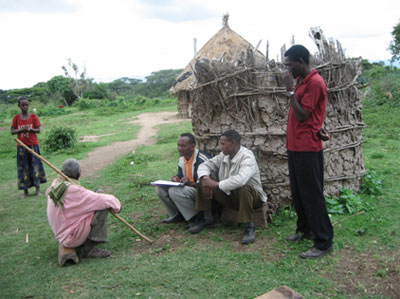
Interview with a male head of household
4. PEN project 2: Yemiru Tesfaye (tyemiru@yahoo.com)
Forest income & poverty alleviation in a participatory forest management arrangement in the Bale Mountains, Southern Ethiopia
The study was conducted in Dodola district (woreda ) in the Bale Mountains, 320 kilometres south of Addis Ababa. The Bale Mountains feature the largest continuous area above 3000 metres above sea level in East Africa. The forest is an evergreen dry afromontane forest with these main species: Hagenia abyssinica, Juniperus procera, Podocarpus falcatus, Hypericum lanceolatum, Erica arborea, Allophylus abyssinicus, and Maytenus addat.
The participatory forest management project organised the local community to form a Forest Dwellers Association (WAJIB). WAJIB members are required to protect the forest, to carry out management activities and to pay annual forest rent. Members also have the right to live in the forest, to receive forest-based benefits, and to graze livestock in the forest. The number of member households per WAJIB is limited to 30.
With the poverty line set at US$1 per day the poverty incidence among sampled households is 31.7% which is lower than the national level of 39.3% estimated in 2004/2005. Forest products constitute an important part of the household income portfolio contributing 34% of total per capita income followed by livestock (30%), crop (26%), and environmental products (6%). Forest income, usually is not fully accounted for in the national estimate. If forest income is excluded, the poverty incidence will rise from 31.7% to 51%. The major forest products identified are fuel wood, poles, timber (planks), wood splits, charcoal, logs, tree branches, wooden tools and medicinal plants. Charcoal, poles and timber are the main cash-generating forest products.
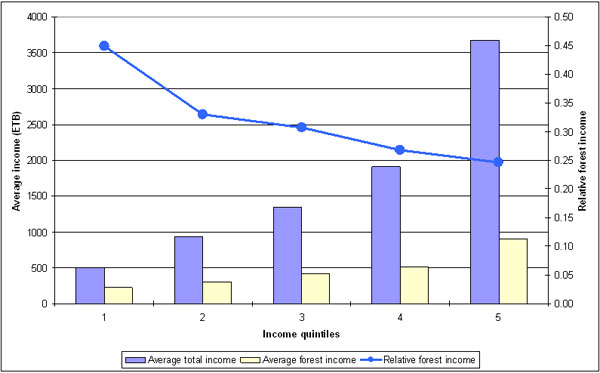
Figure 1. Forest Income and income quintiles for households in the Bale Mountains, Southern Ethiopia, 2007–2008 (NB: The currency conversion rate for the year 2007/08 was 9.2441 ETB/USD).
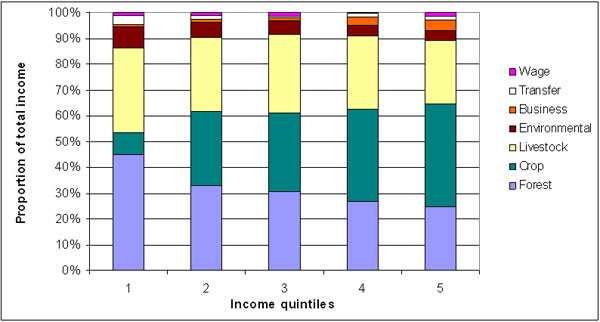
Figure 2. Proportions of income sources per income quintile
Forest products are also the main sources of cash income (53%). Forest cash income helped about 31% of households earn positive net cash income during the first and second quarters when most of the agricultural expenses are incurred. Crops are important as cash income mainly during the third quarter.
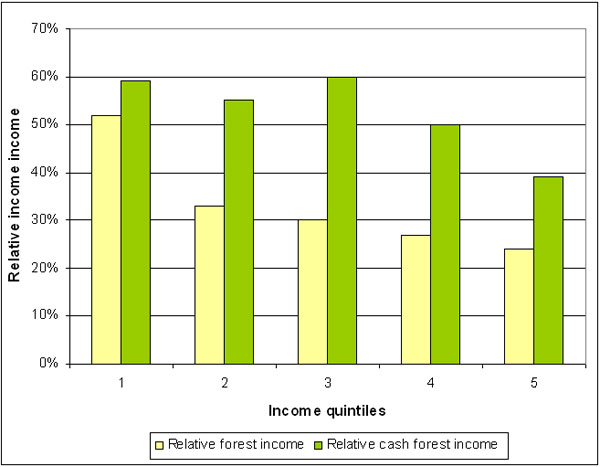
Figure 3. Relative forest income and relative forest cash income by income quintile
Forest income reduces inequality by 15.5% as measured by the Gini coefficient. Increased sale of forest products is the only, main, or part of the coping strategy for 26%, 11%, and 4% (respectively) of households experiencing some kind of crisis,. Households with forest-based coping strategies earned significantly higher forest income than the other groups.
In summary, forest products are important for generating both subsistence and cash income, alleviating poverty, and providing a safety net in hard times. The data shows the prevalence of forest dependence and the significant role forest resources play in the livelihoods of the local people and hence, justifies the need for their involvement in managing forest resources. The better-off households earn more forest income in absolute terms whereas the poorer households depend more on forest resources. Fuel wood is the most important forest product followed by poles and timber. The poorest groups are highly dependent on forest and environmental products, particularly fuel wood.
5. Good reading: Realising REDD+: National Strategy and Policy Options
After all the preparation and hype, the recently completed climate summit (COP15 of the UNFCCC) in Copenhagen did not deliver a new comprehensive agreement on climate change. There were however, smaller and yet significant and encouraging outcomes. One of these was the state of Reducing Emissions from Deforestation and forest Degradation and enhancement of forest carbon stocks (REDD+). Some REDD issues were clarified (scope and rights), and pledges for additional international funding were made.
REDD+ is still perceived as a ‘big, quick and cheap’ way to mitigate climate change. But this apparently brilliant idea of paying forest owners and users for conserving forests is now facing realities on the ground: unclear and contested forest tenure, weak governance, poor systems to measure forest carbon change, etc. How can REDD+ be realised in this environment? A new book by CIFOR, “Realising REDD+: National strategy and policy options”, was launched at COP15 and tries to answer that question. With 23 chapters from 59 authors, the book covers a broad range of policy options and lessons learned. The book is available at CIFOR’s new forest-climate web-page: http://www.forestsclimatechange.org. Hard copies can be obtained from n.sabarniati@cgiar.org.
6. PENroach. Google Search: Uncovering the hidden gems

‘As a rule, we don’t preannounce new features.’
– Eric Schmidt, Google, 2002
For a company that was only founded in 1998, it is remarkable how central Google has become to our digital lives. Most internet users can claim to use Google’s search engine or its many free applications (gmail, maps, Earth, calendar, docs etc), but this usage is only a fraction of what is available. This is mostly because of Google’s policy not to blow its own horn; Google favours working hard to produce great products that sell themselves.
Micheal Agger of Slate has called the search box the new oracle at Delphi – the thing we consult before all major undertakings. That box remains my most used Google application. But the search tool is about more than typing CIFOR PEN to find out about our latest doings. The search tool also has a dictionary, calculator, unit and currency convertors, clock and weather information for major towns, and other great things. You can learn more about search features here.
Related to search tools, let me share a nifty application I recently discovered: LMGTFY (http://lmgtfy.com/). This is for all those people that find it more convenient to bother you with their questions rather than to google it for themselves. See this example: http://tinyurl.com/ye7dj8m.
PS: In preparing this piece, I found this, an article on Google’s Suggest feature. The result is that the experiment ends where it began, with astonishment at the range of human experience that finds its way into the search box. We ask Google … and Google answers, to the best of its collective knowledge, without smirking.
7. We wish everyone a happy and prosperous New Year … and welcome the tiger!
Soon (15. February 2010) we say goodbye to the ox (? ?) and welcome the tiger (??). Like magazine and newspaper horoscopes, there is always something to read into the Chinese years. The ox is the sign of prosperity through fortitude and hard work, illustrating the diligent work put into the creation of the PEN global data bank. Tigers are into deep thinking, which is needed when the data are to be analysed in 2010. These animals are also colorful, powerful, passionate, daring, impulsive, vigorous, stimulating, sincere, affectionate, humanitarian and generous, but can be restless, reckless, impatient, quick-tempered, obstinate, selfish, unpredictable, rebellious and aggressive. Make your pick.
We wish all PEN partners, associates and friends a very happy and prosperous 2010!


