

PEN has Seoul!
CONTENT:
- Updates
- A gathering of PEN souls in Seoul – PEN session at the IUFRO World Congress, Republic of Korea
- Forest and environmental income at the fringes of the Asubima and Buabeng Fiema forest reserves in Ghana
- Forests and rural livelihoods on Cat Ba Island, Vietnam
- Good reading: Forests as safety nets in crisis
- PENroach: A picture is worth 1000 words: Chernoff faces
- Data submission: 37 PEN datasets submitted, 27 have been approved. The rest are undergoing review.
- Congratulations to Ravi Hedge for successfully defending his PhD thesis ‘Payments for ecosystems services and farm household behaviour: the case of carbon in Mozambique’s agro-forests’ on 9 April 2010. Ravi completed his PEN study in Mozambique and was enrolled at the Faculty of Graduate Studies in Forestry at the University of British Columbia in Vancouver.
- PEN to host international conference
‘Counting on the Environment: the Contribution of Forests to Rural Livelihoods’
June 15th, 2011, The Royal Society, London.The purpose of the conference is to increase awareness about the critical links between poverty and the environment; by presenting new research findings and bringing together researchers, policy makers, and practitioners. An intended outcome of the conference is to help putting the environment more firmly onto the poverty agenda, and to strengthen the case for more systematic data collection on the poor’s environmental dependence.Mark your calendars, and stay tuned for more information.

2. A gathering of PEN souls in Seoul – PEN session at the IUFRO World Congress, Republic of Korea

Figure 1: Professor Arild Angelsen (PEN Coordinator) presenting background information about the PEN project (photo by Rita Hasibuan)
PEN hosted a fruitful technical session at the IUFRO World Congress in Seoul in August, attracting 80 participants. The session, ‘Global comparative analysis of local incomes from the forests’, was coordinated by PEN’s Arild Angelsen, Ronnie Babigumira and Nick Hogarth.
Angelsen, who moderated the session, provided some background information and justification for the PEN project, an overview of the methods used and an update on the project’s status. Six PEN partner case studies were then presented. Finally Babigumira presented up-to-date preliminary results from the global analyses.
While all partner cases had unique elements, each presenter grouped the results in a standardised way so as to easily compare and contrast all six. All presenters looked at:
- the average contribution of forest income and the contribution of subsistence compared to cash income
- absolute and relative forest income share according to income quintiles (i.e. forest dependency)
- main sources of forest income
- seasonal variability of forest income.
The seven presentations are included here:
Political ecology of smallholder–environment interactions in the Amazon: changing dynamics with infrastructure development, PDF
Angelica Almeyda Zambrano
Stanford University, Palo Alto, USA
Socioeconomic analysis of the contribution of two palm species to household incomes in the Brazilian Amazon estuary, PDF
Jamie Cotta
University of Copenhagen, Denmark
Forest incomes and poverty alleviation in a participatory forest management arrangement in the Bale Highlands, Southern Ethiopia, PDF
Professor Anders Roos on behalf of PEN partner Yemiru Tesfaye
Swedish University of Agricultural Sciences
Importance of forest income to the livelihoods of households adjoining protected areas in Cameroon, PDF
Ousseynou Ndoye on behalf of PEN partner Juliu s Chupezy
FAO in Cameroon
Forest income contributions to livelihoods in western Democratic Republic of Congo, PDF
Professor Carsten Smith-Hall on behalf of PEN partner Riyong Bakkegaard
University of Copenhagen (
Forests, poverty and rural economic development in Guangxi Province, P.R. China, PDF
Nick Hogarth
Charles Darwin University, Australia.
Quantifying the role of forests in poverty alleviation: Preliminary results from the PEN dataset, PDF
Ronnie Babigumira and Arild Angelsen
CIFOR, Bogor, Indonesia, and the Norwegian University of Life Sciences.
Key messages
The key messages from the session were:
What we knew
- Forest income matters. The forest contributes an average of 20–25 percent of total income share.
- High reliance on forest income is linked to valuable cash crops.
What we thought we knew and needed to modify
- Subsistence forest income is generally for the poor, while cash forest income is for the rich.
- In some but not all cases, forest income serves as a seasonal gap-filler.
What we learned
- In general, forest reliance varies little across income groups.
- Forests’ role as a safety net seems exaggerated.
In addition to presentations at this event, Pen partners presented three posters:
Do forests contribute to rural livelihoods in Ghana?, PDF
Beatrice Darko Obiri
Forest Research Institute of Ghana.
Rural income and forest dependence: some evidence from the western highlands of Guatemala, PDF
José Pablo Prado Córdova
Universidad de San Carlos de Guatemala.
Sustainable forest management for poverty reduction through agroforestry options in the uplands of Eastern Bangladesh, PDF
Syed Rahman
University of Rajshahi, Bangladesh
3. Forest and environmental income at the fringes of the Asubima and Buabeng Fiema forest reserves in Ghana.
By Beatrice Darko Obiri
This PEN study was conducted in communities fringing the Asubima and Buabeng Fiema forest reserves in the forest–savannah transition zone of the Brong Ahafo region of Ghana. The site is characterised by a mean annual rainfall of 1100 millimeters and a population density of 51–100 people per square kilometer. Maize, yam and cassava are the main staples; tobacco and cashew are cash crops. Most households also keep livestock for subsistence. Asubima Forest Reserve covers 7870 ha. It was reserved in 1945 and managed by the Government Forest Services Division. Intensive logging, natural disasters (principally wildfires); encroachment for farming and other illegal activities have rendered the reserve highly degraded with open vegetation and sparse tree growth in some parts. Currently, government-sponsored community forestry programmes and private forest developers are establishing tree plantations to restore parts of the reserve. The Buabeng Fiema Reserve, popular for its monkey sanctuary, is managed as an ecotourism site by the Ghana Tourist Board in collaboration with the Buabeng community living on the edge of the reserve. The area outside the two reserves is predominantly agricultural land in cropping or fallow phases. Vegetation in the reserves and surrounding areas are vital sources of wood and non-wood products that people collect largely for subsistence use.
This article reports the quarterly contribution of income from forests and other environmental sources to household income over a 12-month period. It also gives an indication of the functional role of forests in agricultural livelihoods and explains the factors that likely influence the intensity of collection over the quarters as they coincide with seasonal activities in the agricultural calendar. Overall, agriculture is the key contributor to household income providing 64.5% of total annual household income. Forests and non-forest environmental income contributes 13% and 7% respectively. Remittances, businesses and wages contribute 15.5% (Figure 1). Thus income from direct forest and other environmental sources combined is the second most important contributor providing 20% of annual household income.
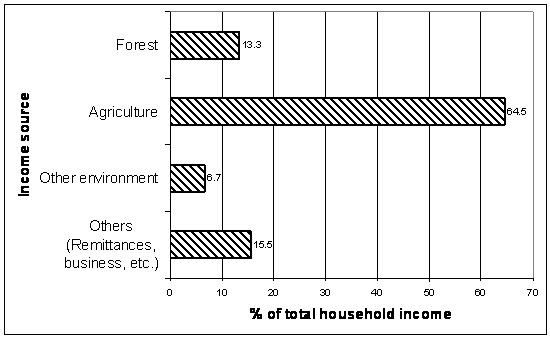
Figure 1. income share by income source grouped by sectors
The survey showed that households collect 38 different products from forests and 50 from non-forest environmental sources. Game meat and fuelwood are the most frequently collected products from these two sources (Figures 2 and 3). Wood constitutes the primary energy source for more than 70% of Ghanaians. Forests serve as the main wood energy ‘bank’ in addition to their important roles in providing food, fodder, construction material and other basic products and services. Game meat is a delicacy in most rural households and also a key commercial forest product in urban centres; it is also exported.
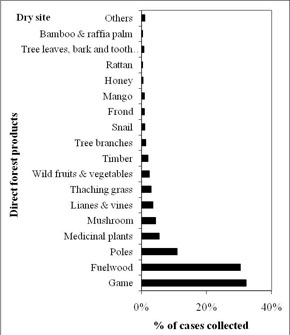
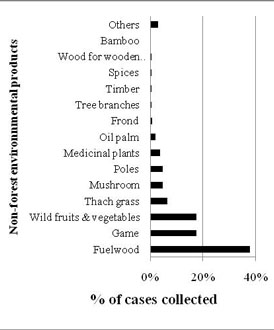
Figure 2 and 3. of products collected from forest and non-forest environment sources
Total mean household income is highest in the first quarter (Figure 4), the period immediately after cropping season. An appreciable amount of food is stored and consumed or sold, as well as idle labour invested in the collection of products, from the forest. The forest is the primary source of environmental products because vegetation in most areas outside the forest (i.e. farms and fallows) is dominated by grasses especally Panicum maximum, Imperata cylidrica and Cencrus ciliaris that do not enhance tree or forest growth. Forest products are collected throughout the year, peaking in the first quarter when agricultural labour isw idle, but declines consistently over the quarters as agricultural production and activities intensify. The least amount of collection takes place in the fourth quarter.
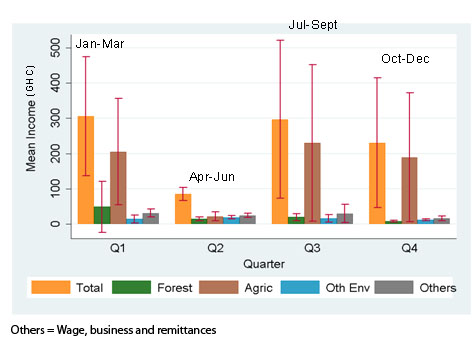
Figure 4. Household seasonality income pattern
The least income is obtained in the second quarter, April–June. This is the lean period when much of the agricultural produce in reserve is consumed or sold. I expected the highest collection of products from forests and other wild vegetation during this period to fill the hunger gap. However, this period is critical to the agricultural season for land preparation, planting and weeding. Agricultural activities intensify with the onset of the rains sometime in April until late November. Hence less labour is available for collection of forest and other environmental products. Environmental income trends do not necessarily follow the agricultural trough, but depend primarily on labour availability. However, such income may be important in the lean period in the second quarter, when they provide at least 45% of the mean total income for households and may fill the gap for food and cash, although at less significant levels (Figure 4). The government is promoting tree plantations for timber production to restore the degraded forest landscape in the study area. However, this study shows that game, fuelwood, poles and medicines are key commodities collected particularly from the forest. Charcoal is also the most frequently processed forest product (62%) mainly for commercial purposes. Thus fuelwood plantations must be promoted and developed on farmland for subsistence. This system can also be managed for charcoal, pole and timber production to reduce pressure on the forest in this degraded ecological zone.
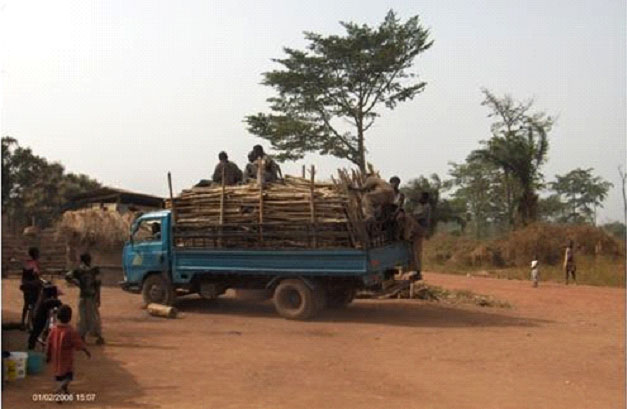
Figure 5. is loaded with fuelwood for sale in the Asubima area in 2008. (Photo by Eric Nutakor)
4. Forests and rural livelihoods on Cat Ba Island, Vietnam
By Dao Huy Giap
This study was conducted on Cat Ba Island, part of Cat Ba National Park (CBNP). The park is situated approximately 150 km northeast of Hanoi, about 8 km off the mainland. The Vietnamese government established the park in 1986, including in its boundaries the islands and adjacent marine areas. The park is an important area for nature conservation with a great variety of landscapes and ecosystems, including tropical evergreen forests, freshwater swamp forest, small freshwater lakes and streams, sandy beaches, mangroves, coral reefs and seagrass beds. The total area of Cat Ba island covers 17,000 ha, the original evergreen forest occupies 9,000 ha.
A total of 155 households from 6 villages (20 to 30 households in each village) were randomly select for the year-long PEN survey in March 2007. The main economic activities of selected households are livestock (86%), direct forest products (85%), crop production (83%), and wage (70%). Less than 50% of households get income from fishery, aquaculture, businesses, payments for forest services and other activities. No household get income from non-forest environmental and forest-derived activities.
Although agriculture is the principal source of income, a significant number of household (85%) depend directly on forest resources. Forest products most widely exploited are firewood, honey, wild fruits, medicinal plants, bamboo shoots, and geckoes. Honey collection takes place in the forest from August to November and from February to April. Groups of honey collectors spend one or two weeks at a time in the forest, during which time they hunt to supplement their diets. The practice of honey collection often results in forest damage. Contributions from forest income to the total household income is more important in the lowest income group than in the higher income groups even though the actual value of the forest income in the lowest group is lower.
Overall, forest income contributes 10%–18% of household income. The lowest income households depend on forest income as much as 18%, while it is only 10% in the highest income households (Figure 1).
For all five wealth groups, forest income contributes 13.1%, fourth after incomes from wages, crops and livestock production. Honey collection, animal-based medicine (geckoes) and fuelwood contributed 34%, 32% and 11%, respectively, of total forest income.
Seasonal income was found to be associated mostly with cropping activities. During the agricultural off-season, people often go fishing or hunting. Nevertheless, incomes from different sources vary across communes and the lowest income levels occur in communes that are closer to the national park. Poverty is one of the main reasons that people collect forest products even though collection in the park is banned.
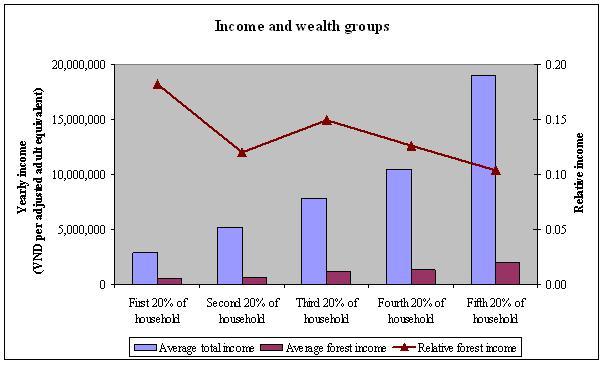
Figure 1. Income and wealth groups
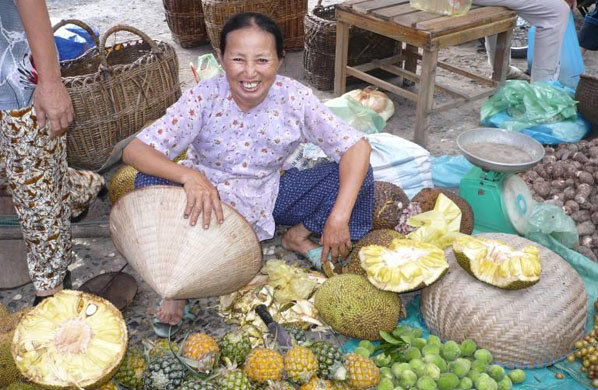
Figure 2. This Cat Ba market seller offers forest fruits alongside agriculture products
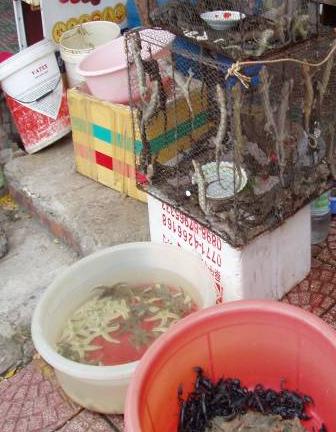
Figure 3. Geckoes and scorpions collected from the forest are sold at Cat Ba town
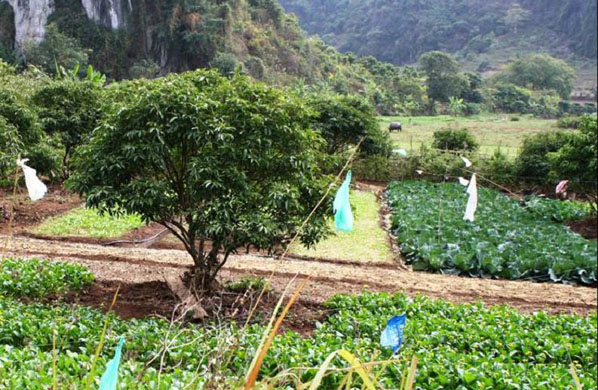
Figure 4. Crop production is mainly for household and local consumption
5. Good reading: Forests as safety nets in crisis
Do forests serve as a safety net for rural people during periods of crisis? PEN’s key question is also being asked by other projects. Völker and Waibel (2010) use data from a project on shocks, vulnerability and poverty in the uplands of Vietnam to provide answers. Shocks are disaggregated along two dimensions to dig deeper into different coping strategies. One group disaggregates covariate (common) and idiosyncratic (household specific) shocks. The second group disaggregates shocks that only affect income or expenditures and those that also reduce household labour supply (e.g. illness). The type of shock has implications for the strategies available. For example, a covariate shock make it less likely that a household will rely on neighbours for assistance, while health shocks should make labour-intensive coping strategies (e.g. forest extraction) less likely.
The authors analyse the impact of weather and health shocks on households’ engagement in forest extraction (a binary variable). They find that severe weather shocks lead to higher engagement in forest extraction. Health shocks (lost labour capacity) among active household members have a similar effect, after controlling for covariates. For example, households with high levels of tangible assets and high levels of education are less likely to be involved in forest extraction.
Völker, Marc and Hermann Waibel (2010) Do rural households extract more forest products in times of crisis? Evidence from the mountainous uplands of Vietnam. Forest Policy and Economics. 12 (8): 407-414. For a copy of the paper, contact the corresponding author, Marc Völker at voelker@ifgb.uni-hannover.de
6. A picture is worth 1000 words: Chernoff faces

What makes a good graph? I would say one that does not let anything get between the reader and the data. Good graphs avoid fancy colors, slices, 3D effects and the like. The reader should quickly and clearly grasp what the data shows. That said, some graphic representations can be quite fun and intriguing. One such display is the Chernoff face which I chanced to find in the Stata Journal (9:3).
Chernoff faces display multivariate data in the shape of a human face. The individual parts, such as eyes, ears, mouth and nose represent values of the variables by their shape, size, placement and orientation. The idea behind using faces is that humans easily recognise faces and notice small changes without difficultyIntrigued? Here is an example courtesy of http://kspark.kaist.ac.kr/Human%20Engineering.files/Chernoff/Chernoff%20Faces.htm
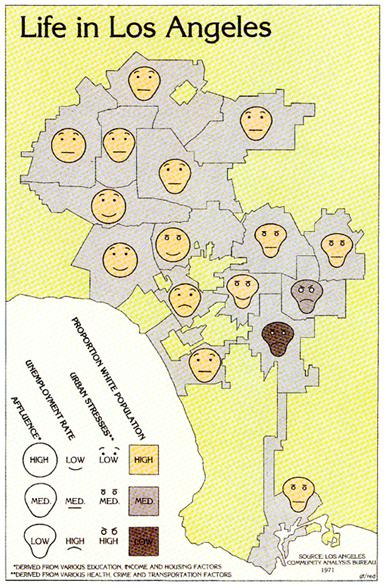
Intrigued? Here is the Stata journal article http://www.stata-journal.com/article.html?article=gr0038.
SAS has a programme was well: http://www.datavis.ca/sasmac/faces.html and I am sure R and other programmes have their implementation.
Happy Chernoffing…
Arild Angelsen, PEN coordinator, arild.angelsen@umb.no
Ronnie Babigumira, PEN Research Fellow, r.babigumira@cgiar.org
Nick Hogarth, PEN partner and consultant, n.hogarth@cgiar.org


