

Preliminary PEN global results presented at The Royal Society in LondonGlobal data and analyses update
CONTENT:
- Global data set and global analyses update
- PEN science workshop summary
- PEN policy conference summary
- Good readings: National parks and poverty; NTFPs in the global context
- PENROACH: May the tweet be with you
1. Global data set and global analyses update
The final numbers for the PEN global data set are 8301 households from 58 sites analysed in 37 PEN partner case studies in 24 countries. Many of the 37 case studies spanned more than one site (an intermediate category between village and case study), which is defined as a homogenous area according to certain key dimensions (e.g. geographic proximity, remoteness, climatic conditions, dominant management regimes).
2. PEN science workshop, University of East Anglia, Norwich

Many of the world’s leading experts in the field of forest–poverty research gathered for the two-day Poverty and Environment Network’s science workshop held at the University of East Anglia in Norwich on 13–14 June 2011. The aim of the workshop was to present the ‘state of the art’ on this issue, and to present draft papers for potential inclusion in the special issue of World Development in which the PEN global results will be published in late 2012 or early 2013.

PEN science workshop participants, University of East Anglia, Norwich, UK (Photo by Rita Hasibuan)
Sixty workshop participants from more than 20 countries attended, following a competitive process in which one-fifth of the abstracts submitted were accepted. Researchers represented a range of institutions, including CIFOR, International Union for the Conservation of Nature, the World Bank’s Development Research Group, UN Environment Programme, Food and Agriculture Organization of the UN, World Conservation Society, International Forestry Resources Institute, World Agroforestry Centre, Ford Foundation and more than a dozen universities. Presenters shared new research findings from around the developing world and discussed research methods, key priorities for future research and policy implications. Further research needs and policy priorities were discussed and ranked. More longitudinal and comparative studies were the top research priority; advancing policy makers awareness of the importance of forest and environmental income was the top policy priority.
Click here for the full workshop report.
3. PEN Conference success at The Royal Society in London

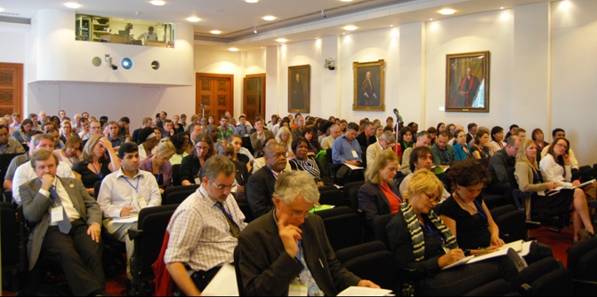
PEN Conference draws an audience at The Royal Society in London (Photo by Kamaluddin Prawiranegara)
The prestigious Royal Society in London was a fitting venue for the final conference of CIFOR’s seven-year Poverty and Environment Network research project (PEN). During this one-day policy conference, preliminary results from the PEN global study were presented to an audience of around 200 leading researchers, academics, policy makers, NGOs and the media. Findings were based on survey data collected from 8000+ rural households living in or near forests, from 58 sites in 24 developing countries. The key preliminary results presented were:
- Forest income constitutes about one fifth of total household income, while environmental income (forest and non-forest) makes up more than one fourth.
- A surprising finding was that overall forest reliance varies little with income levels. (‘Forest reliance’ is the portionof forest income in total household income.) Hence, forest income benefits not just the poor but everyone at the study sites.
- Another surprising finding was that forests play much less of a role as part of household safety nets in response to shocks, and in filling recurrent seasonal income gaps.
- Contrary to what has been claimed, the results from the PEN study found that men bring as many or more forest products to the household as women, although there is a clear pattern of women being more involved in subsistence activities and men in cash-earning activities.
- Firewood constitutes the single most important forest product, contributing to about one fifth of forest income on average, followed by timber which contributes 10%.
- More than a quarter of all sample households had cleared forest area for crops within the last year of the survey, with the most well-off 20% of households clearing 30% more than the poorest 20%. Such results do not lend support to the hypothesis that poverty drives deforestation.
The conference and the preliminary results received a lot of attention from the international media, including articles published in Nature News, American Scientist, Scientific American, The Ecologist and many more (click here for links to the full list).
Click here for the full conference report.
4. Good reading 1: National parks and poverty; NTFPs in the global context
Do national parks exacerbate poverty by restricting poor people’s access to resources or do they provide income generating opportunities? Many studies suggest that poverty is higher along park edges, but that does not mean that parks create poverty; parks tend to be located in remote areas where poverty rates are higher anyway. A new study from Kibale National Park in Uganda combines spatial and socio-economic data over a 10-year period (19962006) to address these issues. The park is not a poverty trap, and changes in income and assets were found to be unrelated to distance to the park. The paper stresses instead that the park provides protection against the greatest poverty risk, namely desperate land sell-offs among the most vulnerable. Allowing local people to extract more non-timber forest products from the park could prevent some from sinking deeper into poverty. Such access permits are nevertheless unlikely to lift a large share of the poor out of poverty.
Naughton-Treves, L., Alix-Garcia, J. and Chapman, C.A. 2011 Lessons about parks and poverty from a decade of forest loss and economic growth around Kibale National Park, Uganda. Proceedings of the National Academy of Sciences 108 (34): 13919–13924. http://www.pnas.org/content/early/2011/08/15/1013332108.abstract.
Good reading 2: Non-timber forest products in the global context
A new volume on non-timber forest products (NTFPs) has just been published. NTFPs have been an active area of research since it was first introduced in the 1980s. This multi-author publication takes stock by providing an up-to-date critical analysis on the benefits and challenges associated with NTFP use and management. It also highlights the complexities and disciplinary nuances of the subject, and tries to place NTFPs within the bigger picture with respect to both livelihoods and landscapes.
Shackleton, S., Shackleton, C. and Shanley, P. 2011 Non-timber forest products in the global context.Tropical Forestry 7. http://www.springerlink.com/content/978-3-642-17982-2/contents/
5. PENROACH

May the tweet be with you
A while back I wrote about blogs and their ever-growing importance as a source of news, opinions, and information about a wide range of issues including research. I also shared a few of the ones I visited regularly.
However, if you are like me and I suppose the majority of today’s netizens, there is just no time to visit or follow – at least not regularly – all the blogs we would like to follow. We are simply overloaded with information, mainly through email. I thought that newsreaders or alerts (e.g. Google alerts) would be a solution, notifying me whenever my favorite bloggers posted something new. I tried a newsreader but found that I only tended to open it once a week, and sometimes only once a month. Email, well, that is the problem to begin with, too many already…
All this changed when I stumbled upon Twitter. I was a skeptic when I first heard about it. Can you really say anything useful in just 140 characters? But I have been very pleasantly surprised. All I had to do was to set up a Twitter account and then search for and follow some great minds working on issues I care about. I’m making it a habit to find a few minutes each day, usually at day’s end, to sign into my Twitter account and voilà, a collection of breezy posts announce new work, share links to interesting papers, and comment on a wide range of issues
Arild Angelsen, PEN coordinator, arild.angelsen@umb.no
Ronnie Babigumira, PEN research fellow, r.babigumira@cgiar.org
Nicholas Hogarth, PEN partner and consultant, n.hogarth@cgiar.org


